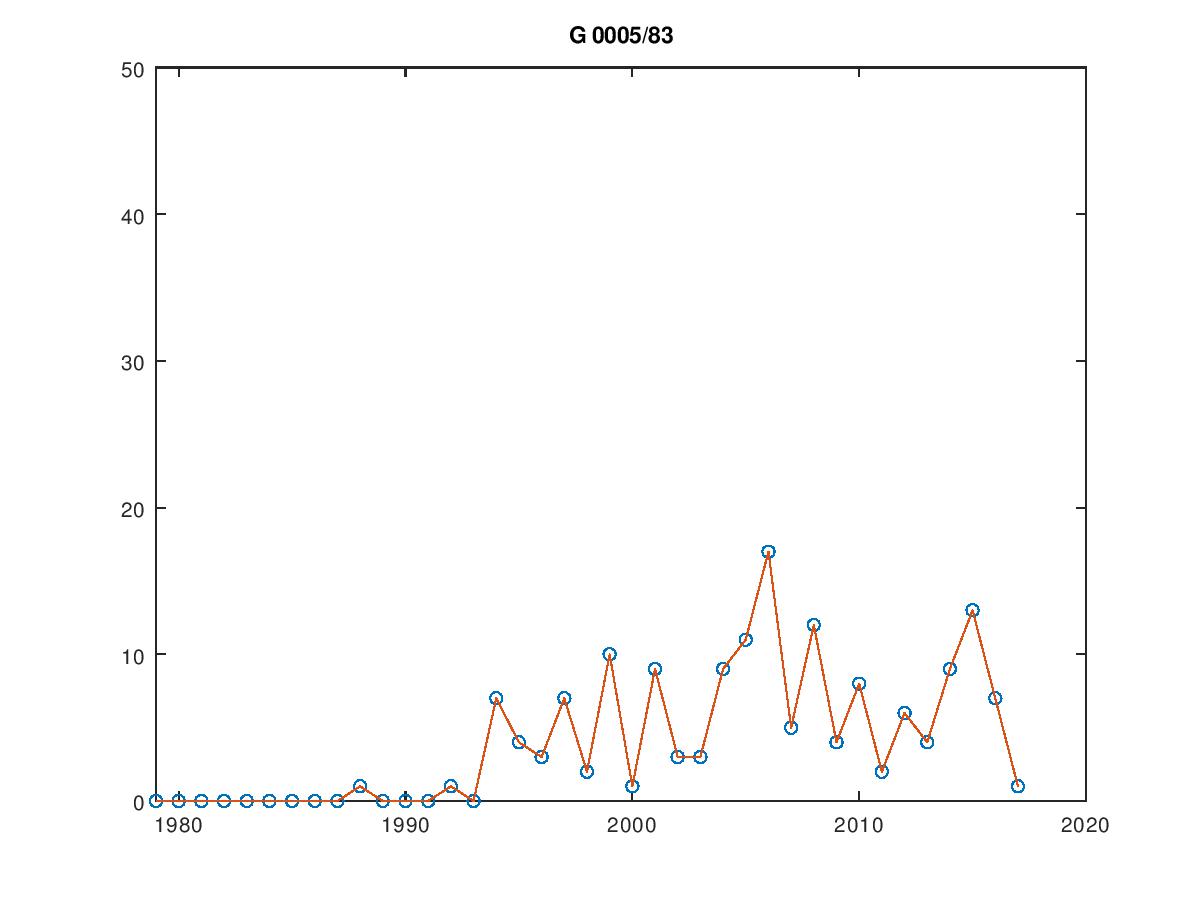
No. of citations: 162
G 5/83 is one of seven(!) parallel cases before the Enlarged Board of Appeals, all dealing with the question of whether or how inventions relating to a "second medical indication" of a chemical compound or composition can be protected under the EPC. These seven decisions were also the very first decisions delivered by Enlarged Board of Appeal.
At the time of G 5/83 there was (and still is today) considerable interest in protecting inventions relating to the "second medical use" or "second medical indication" of chemical entities, i.e., where the compounds or compositions were already known to be useful as medicaments, but for a different disease/in a different indication. The difficulty was that Art. 52(4) EPC1973 in did not allow claims to "methods for treatment of the human or animal body by therapy". More specifically, Art. 52(4) EPC1973 stipulated that such methods were not susceptible of industrial application, one of the three basic patentability requirements. (The exclusion from patentability of therpeutic methods is still present in the EPC2000, but it is implemented in a different manner, namely it is formulated as an "exception to patentability" under Art. 53(c) EPC.)
The German High Court ("Bundesgerichtshof", BGH) had already decided that, under German national law, the subject-matter of a claim directed to the use of a chemical substance to treat an illness extends beyond the treatment of the illness, namely to the preparation for use ("augenfällige Herrichtung"), which, according to the BGH, includes at least the packaging of the substance with instructions for use in the treatment of the illness. A claim directed to the use of a compound to treat an illness could therefore be used in German national law to protect the "second (or further) medical indication".
The Enlarged Board, however, did not agree with the findings of the BGH. In particular, the Enlarged Board found that there was in principle no difference between a method claim and a use claim; it was merely a matter of preference of the applicant whether to formulate a method claim as use claim or vice versa. In this regard, the Enlarged Board stated:
11. The European Patent Convention, in general, allows both method claims and use claims but whether any activity is claimed as a method of carrying out the activity (setting out a sequence of steps) or as the use of a thing for a stated purpose (the sequence of steps being implied), is, in the opinion of the Enlarged Board, a matter of preference. For the European Patent Office there is no difference of substance. In the context of the present case, this means that any artificial distinction according to which, when the invention concerns the employment of a substance or composition for therapy, a method claim excludes and a use claim includes at least the preparation of a pharmaceutical product, with instructions for use in the treatment of illness (which has been called in German the "augenfällige Herrichtung"), cannot be accepted, because in both cases the active substance or composition for therapy must be in a state capable of exerting its therapeutic activity and this necessarily means that the active material has been formulated and made up into doses.Since a second-medical indication claim in the form of a "use claim" was no different than the corresponding claim formulated as "method claim" (the latter being expressly excluded from patentability), no patent could be granted according to the Enlarged Board on a second-medical use claim irrespective of whether it was formulated as "use" or "method claim":
13. For the reasons already given, in the considered opinion of the Enlarged Board, a claim directed to the "use of a substance or composition for the treatment of the human or animal body by therapy" is in no way different in essential content from a claim directed to "a method of treatment of the human or animal body by therapy with the substance or composition". The difference between the two claims is one of form only and the second form of claim is plainly in conflict with Article 52(4) EPC. Since this is so, no patent can be granted including any such claims: Article 97(1) EPC.The Enlarged Board, however, recognised that Article 54(5) EPC1973 provided for the possibility to protect inventions based on the "first medical indication" of a compound or composition, namely in the form of a purpose-limited product claim. The Enlarged Board noted that, apparently, no problem arose with respect to susceptibility of industrial application of such an invention, within the meaning of Article 57 EPC. Furthermore, from the Articles and Rules of the EPC1973, as well as from its legislative history, the Enlarged Board concluded that
"[n]o intention to exclude second (and further) medical indications generally from patent protection can be deduced from the terms of the European Patent Convention: nor can it be deduced from the legislative history of the articles in question." (point 22 or reasons)The Enlarged Board then considered a statement made by the Swiss Federal Intellectual Property Office, stating that they allowed claims to second-medical use inventions in the form of a use claim directed to the use of a substance or composition for the manufacture of a medicament for a specified (new) therapeutic application (point 19 of the reasons).
The Enlarged Board concluded that it is legitimate to allow claims directed to the use of a substance or composition for the manufacture of a medicament for a specified new and inventive therapeutic application, even in a case in which the process of manufacture as such does not differ from known processes using the same active ingredient (point 23 of the reasons).
That claim format was since then referred to as the "Swiss-type claim". It was the claim format of choice to protect second medical indications under the EPC up until G 2/08 ("Dosage regime"). This decision held that under the new wording of the EPC2000 (which allowed purpose-limited product protection for second medical indications, Art. 54(5) EPC), there was no longer room for second-medical use claims in Swiss-type format. The purpose-limited product claim should be used instead.
---
Headnote:
I. A European Patent with claims directed to the use may not be granted for the use of a substance or composition for the treatment of the human or animal body by therapy.The full text of the decision can be accessed here.
II. A European patent may be granted with claims directed to the use of a substance or composition for the manufacture of a medicament for a specified new and inventive therapeutic application.

