Showing posts with label power to examine. Show all posts

Sunday, 30 December 2018

G 0009/91 - Power to examine - #1

Citation rank: 1
No. of citations: 709

The most-cited decision of a Board of Appeal ever, G 9/91, is concerned with the question of whether Opposition Divisions and Appeal Boards have power to examine parts of the patent (i.e., claims), which were not attacked in the initial Notice of Opposition.

G 9/91 was decided by the Enlarged Board in consolidated proceedings with G 10/01. The latter decision looked at a related problem, namely at the question whether Opposition Divisions and Appeal Boards have power to examine Grounds of Opposition (Art. 100(a)-100(c) EPC), which where not raised by opponents within the 9 months opposition period (a brief summary of G 10/91 can be found here).

The claims underlying the referral in G 9/91 were directed to certain anhydride polymers, certain imide polymers, as well as to processes for preparing them. Only the claims relating to the anhydride polymers (not the ones to the imide polymers) were attacked by the opponent. Upon appeal, however, the opponent/appellant also raised objections against the originally non-attacked imide polymer claims. The patentee then offered to dispose of the appeal by deleting Claims 9-11 relating to anhydride polymers. He argued that the Board should not express any opinion on the unopposed Claims 1-8 relating to imide polymers, because this would entail an ex officio examination contrary to Art. 114(1) EPC as interpreted in case T 9/87.

Hence, the question whether an Opposition Division or an Appeal Board had the power to examine originally unopposed claims arose. This question was considered an important point of law within the meaning of Article 112(1)(a) EPC by the Technical Board. It thus referred the following questions to the Enlarged Board of Appeal (G 9/91):
1. Is the power of an Opposition Division or, by reason of Rule 66(1) EPC[1973], of a Board of Appeal to examine and decide on the maintenance of a European patent under Articles 101 and 102 EPC[1973] dependent upon the extent to which the patent is opposed in the notice of opposition pursuant to Rule 55(c) EPC[1973]?
2. If the answer to the first question should be affirmative, are there any exceptions to such dependence?
When approaching these questions, the Enlarged Board found it important to note that the opposition procedure under the EPC is a post-grant procedure.They stated:
"It is inherent in any post-grant opposition procedure that the patent office cannot take any action in respect of a granted patent, however clear it may have become after grant that the patent is invalid, unless initiated by an admissible opposition. If no opposition is filed, the patent can only be attacked in revocation proceedings before a national court. In other words: the competence of the patent office to deal with the patent depends on the action taken by the opponent." (point 3 of the reasons)
The Enlarged Board also took into account that it was a requirement for filing admissible oppositions, that the Notice of Opposition contains, i.a., a statement of the extent to which the European patent is opposed (R. 55(c) EPC1973, now R. 76(2)(c)). The Enlarged Board considered that Rule 55(c) only made sense if it was
"... interpreted as having the double function of governing (together with other provisions) the admissibility of the opposition and of establishing at the same time the legal and factual framework, within which the substantive examination of the opposition in principle shall be conducted." (point 6 of the reasons)

The Enlarged Board also considered the previous case law on the issue. They generally agreed with what was said in T 9/87. The requirements of R. 55(c) EPC1973 to specify the extent to which the patent is opposed within the opposition time limit would be pointless if later on other parts of the patent than those so opposed could freely be drawn into the proceedings (point 10 of the reasons). This would also be contrary to the basic concept of post-grant opposition under the EPC (ibid.).

The Enlarged Board concluded that question 1, above, had to be answered in the affirmative: An Opposition Division or Appeal Board cannot examine unopposed claims which were not attacked during the opposition period. With one exception, though: With reference to T 293/88, the Enlarged Board held that the subject-matter of a dependent claim may be examined as to patentability, if the dependent claim depends from an independent claim which falls in opposition or appeal, provided that the dependent claim's validity is prima facie in doubt on the basis of already available information. The Enlarged Board considered that such dependent subject-matters had to be considered as being implicitly covered by the statement under Rule 55(c) EPC1973.

---

Headnote:
The power of an Opposition Division or a Board of Appeal to examine and decide on the maintenance of a European patent under Articles 101 and 102 EPC depends upon the extent to which the patent is opposed in the notice of opposition pursuant to Rule 55(c) EPC. However, subject-matters of claims depending on an independent claim, which falls in opposition or appeal proceedings, may be examined as to their patentability even if they have not been explicitly opposed, provided their validity is prima facie in doubt on the basis of already available information.
The full text of the decision can be accessed here.

Quotes from 10 decisions citing G 9/91 can be found here

Thursday, 29 November 2018

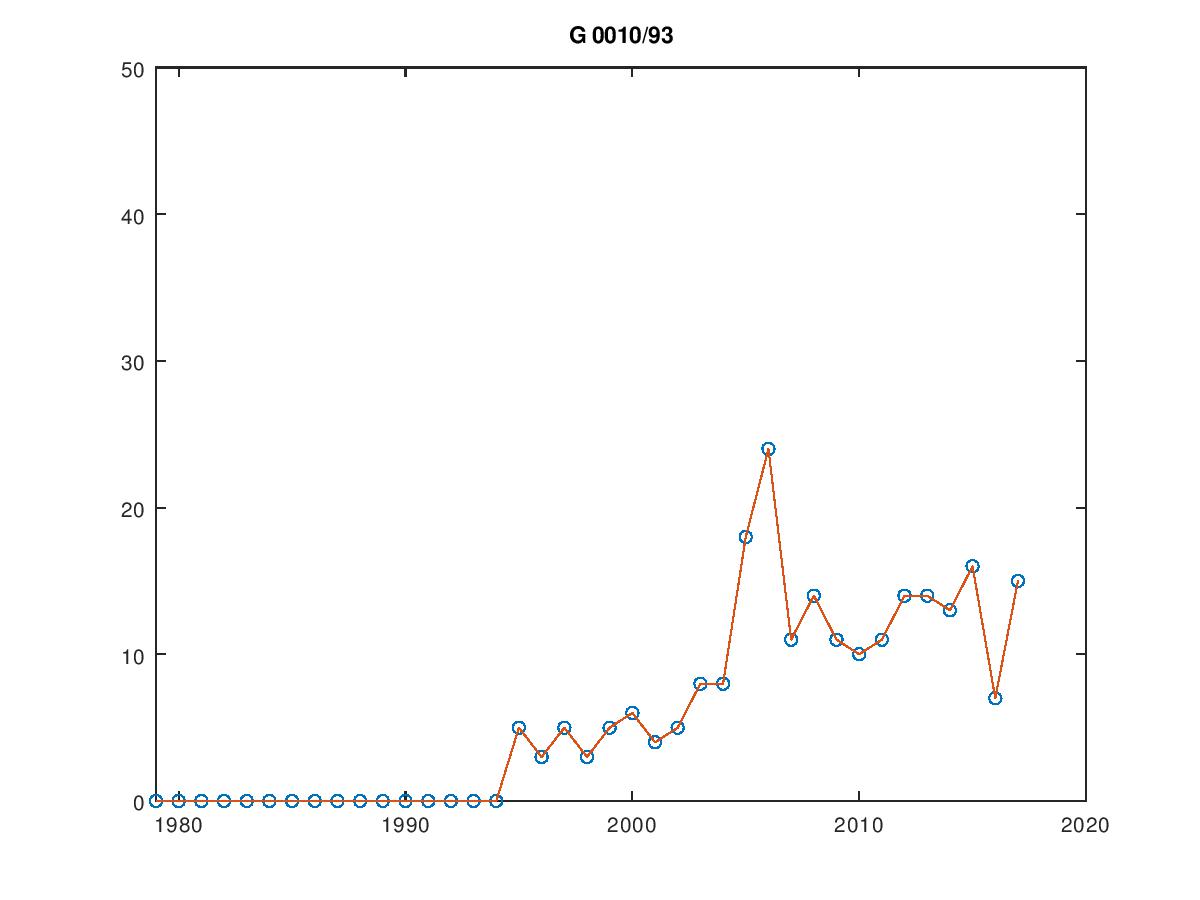
G 0010/93 - Scope of examination in ex parte appeal - #9

Citation rank: 9
No. of citations: 234

G 10/93 is concerned with the question of whether, and to what extent, an Appeal Board in ex parte proceedings (i.e., in examination-appeal cases) can or must examine those requirements, which the Examining Division considered to have been met.

Previously (in G 10/91) the Enlarged Board had taken a strict view on the power of Appeal Boards to consider fresh grounds of opposition in inter partes appeal proceedings. The Enlarged Board held that fresh grounds can only be examined in inter partes appeal proceedings, if the proprietor agrees to the introduction of the fresh grounds into the proceedings. The decision took into account the contentious nature of opposition appeal proceedings and their status as a post-grant procedure.

The Enlarged Board in G 10/93 found that the situation ex parte appeal proceedings is different. They stated:
"In contrast to opposition appeal proceedings, the judicial examination in ex parte proceedings concerns the stage prior to grant and lacks a contentious nature. It relates to the examination of the requirements for the grant of a patent in proceedings in which only one party - the applicant - is involved. The instances responsible must ensure that the conditions for patentability exist. In ex parte proceedings, therefore, the boards of appeal are restricted neither to examination of the grounds for the contested decision nor to the facts and evidence on which the decision is based, and can include new grounds in the proceedings." (point 3 of the proceedings)

The Enlarged Board - on the other hand - also did not consider the examination-appeal procedure a mere continuation of the examination proceedings. In this context they stated:
"The power to include new grounds in ex parte proceedings does not however mean that boards of appeal carry out a full examination of the application as to patentability requirements. This is the task of the examining division. Proceedings before the boards of appeal in ex parte cases are primarily concerned with examining the contested decision. If however there is reason to believe that a condition for patentability may not have been satisfied, the board either incorporates it into the appeal proceedings or ensures by way of referral to the examining division that it is included when examination is resumed." (point 4 of the reasons)
Regarding the question of whether the consideration by the Appeal Board of requirements, which the Examining Division considered to have been met, could be viewed as violation of the principle of interdiction of reformatio in pejus, the Enlarged Board saw no problems. They noted that a decision of an Examination Division to refuse an application meant a total loss of rights. Therefore, any decision of the Appeal Board on the refusal cannot put the applicant in a worse situation than if he had not appealed (point 6 of the reasons). Reformatio in pejus is thus impossible.

Also the appellant's argument in the referring appeal case, a communication from the Examining Division stating that a particular version of an application was patentable would be equivalent to a (partial) grant of a patent, was not accepted by the Enlarged Board. They stated that the Appeal Board had the power to confirm the Examining Division's decision to refuse, even if the contested decision was based on different requirements of the EPC.

---

Headnote:
In an appeal from a decision of an examining division in which a European patent application was refused the board of appeal has the power to examine whether the application or the invention to which it relates meets the requirements of the EPC. The same is true for requirements which the examining division did not take into consideration in the examination proceedings or which it regarded as having been met. If there is reason to believe that such a requirement has not been met, the board shall include this ground in the proceedings.
The full text of G 10/93 can be accessed here.

Thursday, 20 September 2018

G 0001/95 - Fresh grounds for opposition - #40

Citation rank: 40
No. of citations: 109

G 1/95 (and the related G 7/95) investigated what is to be understood under the expression "fresh grounds for opposition", as used in Headnote 3 of the earlier decision G 10/91,  which - according to the earlier G 10/91 - cannot be examined in opposition-appeal proceedings without the consent of the proprietor (G 10/91, Headnote 3).

In the opposition case underlying G 1/95, the referring Technical Board of Appeals noted that the patent had been opposed on the basis of Art. 100(a), but the opposition had been substantiated on the grounds of lack of novelty and inventive step (Art. 54, 56) only. The Technical Board, however, was of the opinion that the claims related to unpatentable subject matter in the sense of Art. 52(2), which is also mentioned as ground for opposition in Art. 100(a) EPC.

The question now arose, whether unpatentable subject matter is the same ground for opposition as lack of novelty and lack of inventive step (namely, "the ground for opposition of Art. 100(a) EPC"), or whether "unpatentable subject matter" must be seen as being an independent ground for opposition, which, according to G 10/91, could not be examined by an Appeal Board without the consent of the proprietor. Previously, the Technical Boards had taken different views on this question.

The Technical Board thus referred the following question to the Enlarged Board:
"In a case where a patent has been opposed on the basis of Article 100(a) EPC, but the opposition has only been substantiated on the grounds of lack of novelty and inventive step pursuant to Articles 54 and 56 EPC, can a board of appeal introduce the ground that the subject-matter of the claims does not meet the conditions of Article 52(2) EPC of its own motion into the proceedings?"
The Enlarged Board noted in point 3.1 of the reasons that, according to established case law, the expression "grounds of appeal" is to be interpreted as including both the legal reasons, i.e., the legal basis, and the factual reasons, i.e., the facts, arguments and evidence relied upon to give to the board all the elements needed to decide whether or not the appealed decision has to be set aside.

Regarding Art. 100(a) EPC the Enlarged Board stated:
"Indeed, Article 100(a) EPC simply refers, apart from the general definition of patentable inventions according to Article 52(1) EPC, and the exceptions to patentability according to Article 53 EPC, to a number of definitions according to Articles 52(2) to (4) and 54 to 57 EPC, which specify "invention", "novelty", "inventive step" and "industrial application" which, when used together with Article 52(1) EPC, define specific requirements and therefore form separate grounds for opposition in the sense of separate legal objections or bases for opposition." (point 4.3 of the reasons)
They concluded that Art. 100(a) EPC contains a collection of different legal objections, or different grounds for opposition, and is thus not directed to a single ground for oppostion (point 4.6 of the reasons).

Therefore, in accordance with Headnote 3 of G 10/91, the ground for opposition of "unpatentable subject matter" was a fresh ground for opposition, which could not be examined by a Technical Board of Appeal, if the opposition had been substantiated only with respect to lack of novelty and lack of inventive step, unless the patentee agrees.

---

Headnote:
In a case where a patent has been opposed on the grounds set out in Article 100(a) EPC, but the opposition has only been substantiated on the grounds of lack of novelty and lack of inventive step, the ground of unpatentable subject-matter based upon Articles 52(1) and (2) EPC is a fresh ground for opposition and accordingly may not be introduced into the appeal proceedings without the agreement of the patentee.
The full text of the decision can be found here.

Quotes from 10 random decisions citing G 1/95 can be found here.

Popular posts