Showing posts with label Art. 84 EPC. Show all posts

Monday, 19 November 2018

T 0409/91 - Sufficiency of disclosure vs. support by the desciption - #13

Citation rank: 13
No. of citations: 205

T 409/91 looked at the relationship between sufficiency of disclosure (Art. 83) and support by the description (Art. 84). It found that both are interrelated, because they both express the same principle, namely that the scope of protection should be commensurate with the contribution that the invention makes to the prior art (point 3.5 of the reasons).

Claim 1 of the application in dispute read:
"Distillate fuel oil boiling in the range 120 C to 500 C which has a wax content of at least 0.3 weight% at a temperature of 10 C below the Wax Appearance Temperature, the wax crystals at that temperature having an average particle size less than 4000 nanometres."
Claims 2 to 5 defined smaller upper limits of the particle size down to 1000 nanometres. It was claimed by the applicant that the small size of the wax crystals reduced the undesired "cold clogging" otherwise observed with wax crystals in fuel oils.

Only one way of obtaining "wax crystals at that temperature having an average particle size less than 4000 nanometers" was disclosed in the application as-filed, namely a process which produced wax particles having an average particle size of 1200 nm. No way of obtaining wax crystals of 1000 nm (as claimed in claim 5) was disclosed.

The Examination Division refused the application for two reasons: Firstly they found that claim 1 was insufficiently disclosed, because the invention could not be carried out within the whole area claimed, i.e., no method was disclosed yielding a particle size of less than 1200 nm. Secondly, the Examination considered that the claim did not meet the requirement of Art. 84, first sentence, in combination with Rule 29(1) EPC1973 (now Rule 43(1)), so that the claim as a whole did not define (state all the essential elements of) the matter for which protection was sought (i.e. the fuel oil) in terms of technical features.

The Appeal Board analysed the application and concluded that for obtaining the inventive small wax crystals, the presence of certain "additives", which were disclosed in the description and present in all of the "examples", were indeed necessary to obtain the inventive small wax crystals. The Board hence considered the presence of such additives was an "essential feature" of the invention, which was missing in the claims. With reference to T 133/85 they stated that a technical feature which is described and highlighted in the description as being an essential feature of the invention, must also be a part of the independent claim or claims defining this invention (point 3.3 of the reasons). The claims thus infringed Art. 84 EPC.

The Board also found that the claims lacked sufficiency of disclosure (Art. 83) for very similar reasons. The Board stated:
"Although the requirements of Article 83 and Article 84 are directed to different parts of the patent application, since Article 83 relates to the disclosure of the invention, whilst Article 84 deals with the definition of the invention by the claims, the underlying purpose of the requirement of support by the description, insofar as its substantive aspect is concerned, and of the requirement of sufficient disclosure is the same, namely to ensure that the patent monopoly should be justified by the actual technical contribution to the art." (point 3.5 of the reasons)
The Board judged that the reasons why the claims were insufficiently disclosed in this case were in effect the same as those that lead to their infringing Art. 84 EPC, namely that the invention extends to technical subject-matter not made available to the person skilled in the art by the application as filed,. In particular, as was not contested by the appellant, no information was given to perform the claimed invention successfully without using the structurally defined "additives".

The Applicant argued that the claims were sufficiently disclosed, for the reason alone that the application disclosed one way of carrying out the invention. However, the Board did not accept this. They stated:
"... the Board does not accept the appellant's submission that sufficiency should be acknowledged simply because one way of performing the invention was disclosed. In the Board's judgement, the disclosure of one way of performing the invention is only sufficient within the meaning of Article 83 EPC if it allows the person skilled in the art to perform the invention in the whole range that is claimed ...".
As a consequence, the appeal was dismissed.

Remark: It remarkable that the Board in this case considered the invention to be insufficiently disclosed, although the required features for obtaining the small wax crystals (i.e., the required "additives") were disclosed in the description. The argument frequently made by applicants and proprietors, that it is sufficient for complying with Art. 83 that the description taught how to carry out the invention, is hence not always correct. If essential features are missing in a claim, the claim effectively extends to embodiments that are not accessible with the information given in the patent/application (namely those embodiments that do not employ the essential features), and therefore the invention as defined by the claims - as a whole - is insufficiently disclosed.

---

Headnote:
The questions of sufficiency and of support by the description are questions of fact which have to be answered on the basis of the available evidence having regard to the balance of probabilities in each individual case. Although the requirements of sufficient disclosure of the invention (Art. 83 EPC) and support by the description (Art. 84 EPC) are related to different parts of the patent application, they give effect to the same legal principle that the patent monopoly should be justified by the technical contribution to the art. Therefore, the extent to which an invention is sufficiently disclosed is also highly relevant for the answer to the question of support (points 3.3 to 3.5 of the Reasons).
The full text of the decision can be found here.


Quotes from decisions citing T 409/91 can be found here.

Tuesday, 13 November 2018

T 0301/87 - Clarity in opposition proceedings (pre-G 3/14) - #15

Citation rank: 15
No. of citations: 191

T 301/87 is one of many decisions concerned with the question of whether and to what extent clarity objections can be examined in opposition. It represents one of two "diverging" schools of case law, which were considered by the Enlarged Board of Appeal when they looked at the same question in G 3/14. G 3/14 ultimately followed the approach taken by T 301/87, i.e., that clarity objections are to be examined only if the clarity objections arise out of the amendments made during opposition. (G 3/14 added an additional restriction to the examination of clarity objections in opposition, namely that the clarity objection can only be examined to the extent that the clarity objection arises from the amendment.)

Consideration was given in T 301/87 (and G 3/14) to the fact that, on the one hand, clarity is not included in the (exhaustive) list of grounds for opposition of Art. 100 EPC, but Art. 101(3) requires that the opposition division considers whether the amended patent "meets the requirements of [the EPC]" (with no reference to Art. 100 EPC).

T 301/87 appears still valid after publication of G 3/14, but G 3/14 of course carries more weight and is nowadays the decision to be cited. G 3/14 (rank #16 in the list of most-cited Board of Appeal decisions) has recently been summarised in this blog here.

---

Headnote:
1. When amendments are made to a patent during an opposition, Article 102(3) EPC requires consideration as to whether the amendments introduce any contravention of any requirement of the Convention, including Article 84 EPC; Article 102(3) EPC does not allow objections to be based upon Article 84 EPC, if such objections do not arise out of the amendments made (further to T 227/88, dated 15 December 1988) (cf. Point 3.7 of the reasons)
[...]

 The full text of the decision can be found here.

Friday, 9 November 2018

G 0003/14 - Clarity in oppostion proceedings - #16

Citation rank: 16
No. of citations: 186

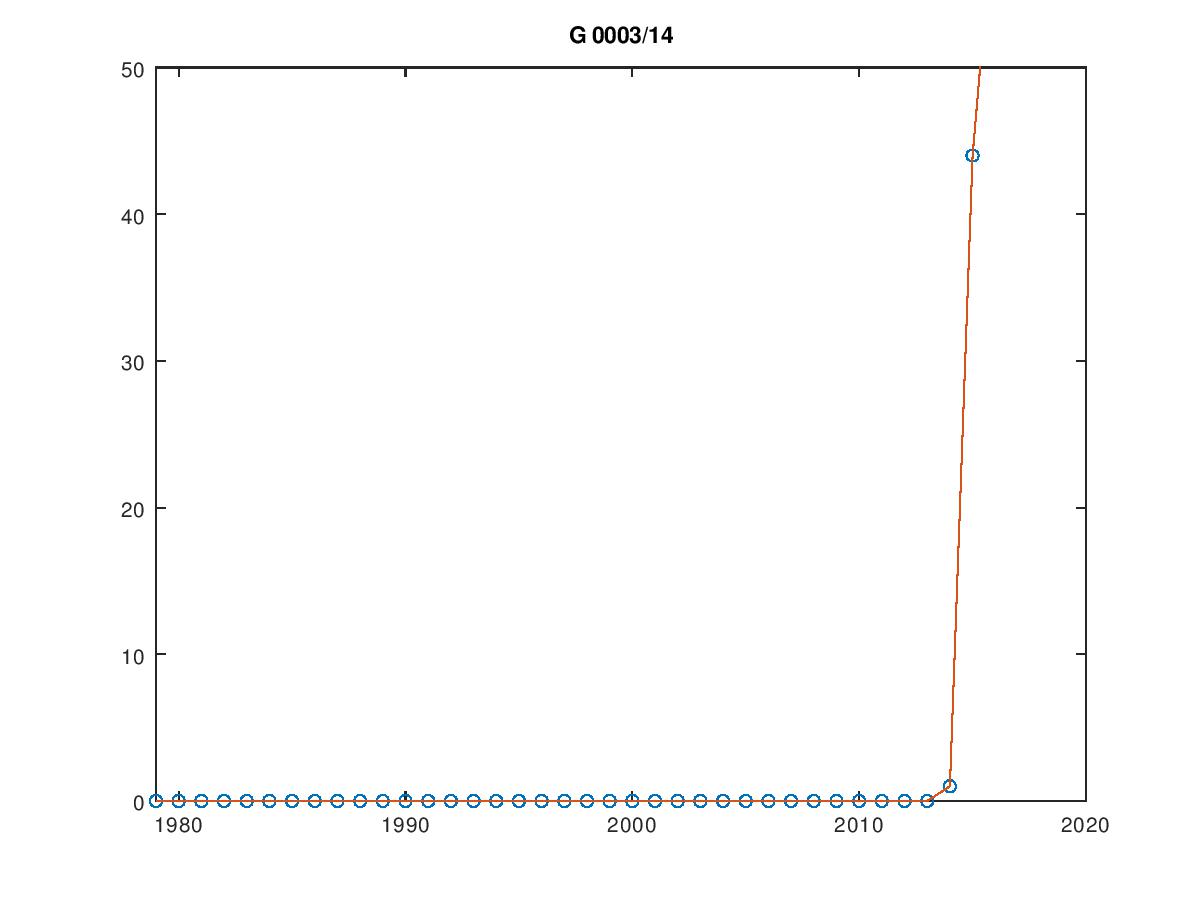
G 3/14 ranks #16 on the list of the 100 most-cited Boards of Appeal decisions of all times, but it is certainly record-holder in terms of citations per year! (see graph right/above)

The decision is concerned with the question of how the requirement of the EPC that a claim should be clear, concise and supported by the description (Art. 84 EPC) is to be treated in opposition and opposition-appeal.

The question arises from the fact that Art. 100 EPC limits the available grounds of opposition to the ones listed in that Article (and Art. 84 is not among them), but Art. 101(3)(b) on the other hand states an opposition must revoke a patent which has been amended in opposition and no longer "meets the requirements of [the EPC]".

The case law concerning the question was divergent. Some Boards were of the opinion that clarity objections against amended claims are to be examined in opposition only to the extent that the clarity objections result from the amendment(s) (e.g., T 301/87). Other Boards, starting with T 1459/05, allowed opposition divisions more flexibility. In the most flexible approach, the power of an opposition division to examine clarity objections against amended claims was unrestricted.

In deciding the questions referred to it, the Enlarged Board considered the wording of Art. 101(3) EPC, which - in relation to amended patents - refers to "the requirements of this Convention" and not only to the grounds of oppositions mentioned in Art. 100 EPC. The fact that the grounds available for opposition are deliberately limited by the EPC to the ones listed in Art. 100(a), (b) and (c) was also taken into account.

After a detailed analysis of the earlier case law and of the text of the EPC, the Enlarged Board came to the conclusion that under Art. 100 and 101(3) EPC, the power of Opposition Divisions (and of Appeal Boards) to examine amended claims under clarity is limited to cases where, and to the extent that, the clarity objections arise from the amendment(s).

Under this concept, e.g., when an opposed patent is amended by inclusion of the features of a dependent claim into the independent claim, a clarity issue, which already existed in the unamended dependent claim, cannot be examined by the Opposition Division.

---

Headnote:
In considering whether, for the purposes of Article 101(3) EPC, a patent as amended meets the requirements of the EPC, the claims of the patent may be examined for compliance with the requirements of Article 84 EPC only when, and then only to the extent that the amendment introduces non-compliance with Article 84 EPC.
The full text of the decision can be found here.

Tuesday, 25 September 2018

T 0068/85 - Allowability of functional features ("Synergistic herbicides") - #37

Citation rank: 37
No. of citations: 112

T 68/85 is concerned with the conditions under which functional features are allowed in patent claims.

Claim 1 in the underlying examination case related to: "An agent for selective weed control based on a mixture of [a substance II with a substance Ia or Ib] in a quantity producing a synergistic herbicidal effect."

A synergistic effect of substance II with substances Ia or Ib was demonstrated in the application as filed, albeit only within relatively narrow concentration ranges.

The Examining Division had refused the patent application for lack of sufficient disclosure (Art. 83 EPC). They were of the opinion that the skilled person "could not prepare mixtures that were genuinely synergistic ... without knowing the range of ratios in which ingredients had to be mixed". And further, in the eyes of the Examining Division, it had "not been demonstrated that the synergistic effect ... occurred throughout the claimed range".

The applicant filed an appeal against the refusal.

The Board in T 68/85 did not find the Art. 83 objection justified. They stated that the patent application as a whole must contain sufficient information to make the claimed synergistic mixtures of substance II with substances Ia or Ib, and suitable weight ratios were disclosed in the description.

Regarding the presence of a functional feature in claim 1 (i.e., "... in a quantity producing a synergistic herbicidal effect"), the Board noted:
"However, the applicant cannot simply define a feature in a claim as he wishes; he must choose the form that is objectively more precise (T 14/83). This requirement is met in the present case as the Board does not see how the limits within which the two herbicide couples combine to give a synergistic effect could be defined more precisely than has been done without limiting the scope of the invention. Accepting the Examining Division's suggestion and including in Claim 1 [specific concentration ranges of substances II and Ia or Ib] so as to render the former more precise would mean limiting the scope of the invention unjustifiably to a particular range of weight ratios and thus unacceptably restricting protection to only part of the invention as disclosed." (point 8.4.2 of the reasons)
However, the Board also noted that a claim may not include a functional feature, if
"... it jeopardises the clarity of a claim as required by Article 84 EPC. That clarity demands not only that a skilled person be able to understand the teaching of the claim but also that he be able to implement it. In other words, the feature must provide instructions which are sufficiently clear for the expert to reduce them to practice without undue burden, if necessary with reasonable experiments."
The Board thus examined whether the application included sufficient information for the skilled person to make synergistic mixtures of substances II and Ia or Ib for the relevant combinations of crops to be protected and crops to be decimated. The Board noted in this regard that the application disclosed specific examples of synergistic concentration ranges, which the skilled person could use as guidance or starting points. The application also disclosed reproducible test methods to establish whether synergistic effects were present. The test methods even allowed to quantify the synergistic effect. The Board observed that the tests were cumbersome (because seeds had to first germinate, before an effect could be observed), but this would be reasonable; in fact usual in the field of herbicides. Therefore the use of a functional feature to functionally express the weight ratios of the synergistic compounds in the mixture was considered to be in accordance with Art. 84.

Finally, the Board also regarded the claimed synergistic mixtures inventive over the prior art. The case was hence remitted to the Examining Division with the order to grant a patent.

---

Headnote:
Functional features defining a technical result are permissible in a claim, if from an objective viewpoint, such features cannot otherwise be defined more precisely without restricting the scope of the invention, and if these features provide instructions which are sufficiently clear for the expert to reduce them to practice without undue burden, if necessary with reasonable experiments.
The full text of the decision can be found here.

Quotes from decisions citing T 68/85 can be found here.

Thursday, 5 July 2018

T 0608/07 - Ambiguities in the claim (sufficiency vs. clarity) - rank #97

Rank: 97
Number of citations: 55

This appeal against a decision of an opposition division in case deals with the question of whether and when difficulties in determining the scope of the claim, i.e., ambiguities, are to be regarded a clarity issue (not a ground of opposition) or as pointing towards insufficiency of disclosure (a ground of opposition, Art. 100(b)).

An earlier decision, T 256/87, held that - in order to be able to carry out an invention - the skilled person must know whether a certain embodiment "falls within the forbidden area of the claim" or not. Otherwise, the invention could not be carried out in a targeted manner.

Since then, T 256/87 has been used by opponents to interpret a clarity issues as a lack of sufficieny. Also the respondent/opponent in T 608/07 made a similar attack under Art. 100(b) against the claims at issue.

The claims in T 608/07 defined a polymerisation process, in which two "incompatible catalysts" were used. The description provided a definition of the term "incompatible catalyst", which was, i.a., based on a comparison of the average molecular weights of the polymers that were produced by each of the catalysts. The numerical value of the average molecular weight of a polymer, however, depends on how the average molecular weight is calculated. Specifically, it plays a significant role whether the weight average molecular weight (Mw) is used, or whether the number average molecular weight (Mn) is used. The opponent showed that using the number average mean molecular weight, two tested catalysts were to be regarded as "compatible", whereas using weight average molecular weight, the same two catalysts were "incompatible". The respondent/opponent argued that this resulted in a situation where the skilled person could not carry out the invention.

Under the specific circumstances of the case, the Board found that the skilled person would readily understand the expression "molecular weight" to mean weight average molecular weight. The alledged difficulty in deciding whether one operates "within the forbidden area of the claim" therefore did not exist.

However, the Board added a general statement on the "forbidden-area" concept of T 256/87. The Board stated:
"2.5.2 The issue of insufficiency dealt with in T 256/87 and the present case is an insufficiency which arises through ambiguity. Although the board accepts that, depending upon the circumstances, such an ambiguity may very well lead to an insufficiency objection, it should be born in mind that this ambiguity also relates to the scope of the claims, ie Article 84 EPC. Since, however, Article 84 EPC is in itself not a ground of opposition, care has to be taken that an insufficiency objection arising out of an ambiguity is not merely a hidden objection under Article 84 EPC. It is the conviction of this board that for an insufficiency arising out of ambiguity it is not enough to show that an ambiguity exists, eg at the edges of the claims. It will normally be necessary to show that the ambiguity deprives the person skilled in the art of the promise of the invention. It goes without saying that this delicate balance between Article 83 and 84 EPC has to be assessed on the merits of each individual case."
In other words, not in every case where there is ambiguity in the claims, this can be translated into insufficiency of disclosure. Only where the ambiguous feature concerns the core of the invention, as opposed to the "edges of the claims", then an objection under Art. 83/100(b) may be justified.

Since then, the question of whether ambiguity in the claims is a matter of clarity or sufficiency of disclosure had frequently been debated in opposition proceedings.

A recent decision (T 2290/12, mentioned in the EPO's 2017 Case Law Report, Suppl. Publ. 3 of the OJ) has summarised the debate and concluded that the "forbidden area" concept of T 256/87 has only been followed in four decisions, whereas the approach of T 608/07 was applied in more than 20 cases. The Board in T 2290/12 stated that the "forbidden area" concept "appeared to have been dropped".

The "forbidden area" concept, however, is not dead. In T 1914/11 the Board found that difficulties in determining the "transient pH in the mouth" of a subject resulted in insufficiency of disclosure. The patent was revoked under Art. 100(b). More recently, in T 626/14, difficulties in measuring the thickness of a "fluffy absorbent core", which was a parameter used to define the invention, rendered claim 1 insufficiently disclosed.

Generally, however, ambiguities in patent claims are nowadays more likely to be regarded a matter of clarity than insufficient disclosure.

---

Headnote:
none
The full text of the decision can be found here.