Showing posts with label appeal procedure. Show all posts

Sunday, 30 December 2018

G 0009/91 - Power to examine - #1

Citation rank: 1
No. of citations: 709

The most-cited decision of a Board of Appeal ever, G 9/91, is concerned with the question of whether Opposition Divisions and Appeal Boards have power to examine parts of the patent (i.e., claims), which were not attacked in the initial Notice of Opposition.

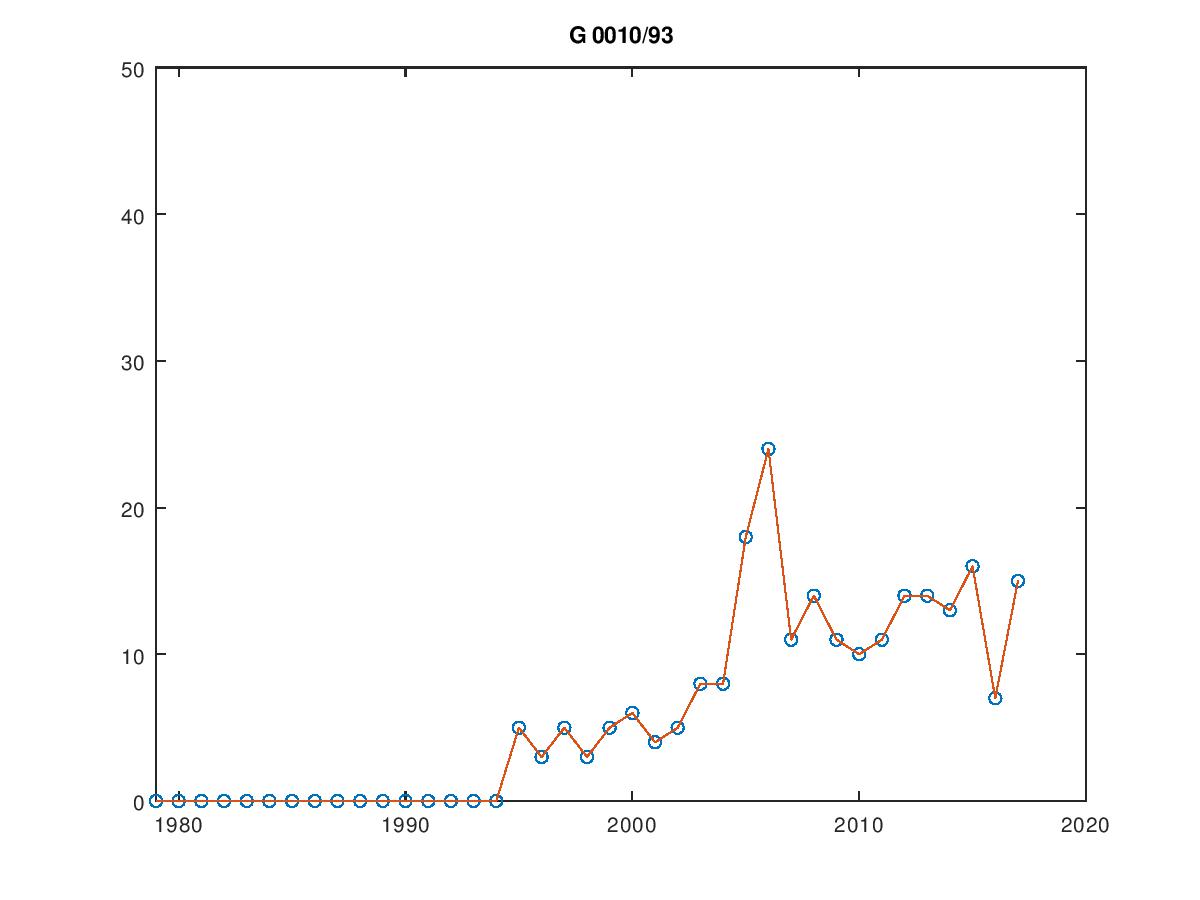
G 9/91 was decided by the Enlarged Board in consolidated proceedings with G 10/01. The latter decision looked at a related problem, namely at the question whether Opposition Divisions and Appeal Boards have power to examine Grounds of Opposition (Art. 100(a)-100(c) EPC), which where not raised by opponents within the 9 months opposition period (a brief summary of G 10/91 can be found here).

The claims underlying the referral in G 9/91 were directed to certain anhydride polymers, certain imide polymers, as well as to processes for preparing them. Only the claims relating to the anhydride polymers (not the ones to the imide polymers) were attacked by the opponent. Upon appeal, however, the opponent/appellant also raised objections against the originally non-attacked imide polymer claims. The patentee then offered to dispose of the appeal by deleting Claims 9-11 relating to anhydride polymers. He argued that the Board should not express any opinion on the unopposed Claims 1-8 relating to imide polymers, because this would entail an ex officio examination contrary to Art. 114(1) EPC as interpreted in case T 9/87.

Hence, the question whether an Opposition Division or an Appeal Board had the power to examine originally unopposed claims arose. This question was considered an important point of law within the meaning of Article 112(1)(a) EPC by the Technical Board. It thus referred the following questions to the Enlarged Board of Appeal (G 9/91):
1. Is the power of an Opposition Division or, by reason of Rule 66(1) EPC[1973], of a Board of Appeal to examine and decide on the maintenance of a European patent under Articles 101 and 102 EPC[1973] dependent upon the extent to which the patent is opposed in the notice of opposition pursuant to Rule 55(c) EPC[1973]?
2. If the answer to the first question should be affirmative, are there any exceptions to such dependence?
When approaching these questions, the Enlarged Board found it important to note that the opposition procedure under the EPC is a post-grant procedure.They stated:
"It is inherent in any post-grant opposition procedure that the patent office cannot take any action in respect of a granted patent, however clear it may have become after grant that the patent is invalid, unless initiated by an admissible opposition. If no opposition is filed, the patent can only be attacked in revocation proceedings before a national court. In other words: the competence of the patent office to deal with the patent depends on the action taken by the opponent." (point 3 of the reasons)
The Enlarged Board also took into account that it was a requirement for filing admissible oppositions, that the Notice of Opposition contains, i.a., a statement of the extent to which the European patent is opposed (R. 55(c) EPC1973, now R. 76(2)(c)). The Enlarged Board considered that Rule 55(c) only made sense if it was
"... interpreted as having the double function of governing (together with other provisions) the admissibility of the opposition and of establishing at the same time the legal and factual framework, within which the substantive examination of the opposition in principle shall be conducted." (point 6 of the reasons)

The Enlarged Board also considered the previous case law on the issue. They generally agreed with what was said in T 9/87. The requirements of R. 55(c) EPC1973 to specify the extent to which the patent is opposed within the opposition time limit would be pointless if later on other parts of the patent than those so opposed could freely be drawn into the proceedings (point 10 of the reasons). This would also be contrary to the basic concept of post-grant opposition under the EPC (ibid.).

The Enlarged Board concluded that question 1, above, had to be answered in the affirmative: An Opposition Division or Appeal Board cannot examine unopposed claims which were not attacked during the opposition period. With one exception, though: With reference to T 293/88, the Enlarged Board held that the subject-matter of a dependent claim may be examined as to patentability, if the dependent claim depends from an independent claim which falls in opposition or appeal, provided that the dependent claim's validity is prima facie in doubt on the basis of already available information. The Enlarged Board considered that such dependent subject-matters had to be considered as being implicitly covered by the statement under Rule 55(c) EPC1973.

---

Headnote:
The power of an Opposition Division or a Board of Appeal to examine and decide on the maintenance of a European patent under Articles 101 and 102 EPC depends upon the extent to which the patent is opposed in the notice of opposition pursuant to Rule 55(c) EPC. However, subject-matters of claims depending on an independent claim, which falls in opposition or appeal proceedings, may be examined as to their patentability even if they have not been explicitly opposed, provided their validity is prima facie in doubt on the basis of already available information.
The full text of the decision can be accessed here.

Quotes from 10 decisions citing G 9/91 can be found here. 

Saturday, 29 December 2018

G 0010/91 - Examination of opposition-appeals - #2

Citation rank: 2
No. of citations: 665

G 10/91 (in consolidated proceedings with G 9/01) is concerned with the character and nature of the opposition and opposition-appeal proceedings. Both G decisions defined powers of Opposition Divisions and Appeal Boards to examine the case. While G 9/91 was concerned with the question of which parts (i.e., which claims) of the contested patent may be examined, G 10/91 looked at the Grounds of Opposition, as provided in Art. 100(a)-(c) EPC, which may be considered by the Opposition Division or Board.

In the underlying case leading to the referral (T 580/89), only certain claims of the opposed patent were actually opposed (namely, under Art. 100(a) EPC). Other claims were not attacked. Also, no other Grounds of Opposition than Art. 100(a) was raised. Upon appeal, however, the opponent then also raised objections against the originally non-attacked claims. Furthermore, in the course of the appeal proceedings a third party filed observations under Art. 115 EPC, submitting that the subject-matter relating to all claims was not patentable due to lack of novelty and inventive step.

In this situation the the question arose whether the originally non-attacked claims may be examined by the Board, despite the fact that the original opposition did not concern these claims. The Board found that this the question was an important point of law within the meaning of Article 112(1)(a) EPC. It thus referred the following questions to the Enlarged Board of Appeal (reference number G 9/91):
1. Is the power of an Opposition Division or, by reason of Rule 66(1) EPC, of a Board of Appeal to examine and decide on the maintenance of a European patent under Articles 101 and 102 EPC dependent upon the extent to which the patent is opposed in the notice of opposition pursuant to Rule 55(c) EPC?
2. If the answer to the first question should be affirmative, are there any exceptions to such dependence?
At that stage, the President of the EPO, making use of his power under Article 112(1)(b) EPC, referred the following question to the Enlarged Board of Appeal (reference number G 10/91):
Is the Opposition Division in the examination of the opposition obliged to consider all the grounds for opposition referred to in Article 100 EPC or is this examination restricted to the grounds referred to by the opponent in his statement of grounds of opposition?
The Enlarged Board of Appeal considered that the questions referred by the Technical Board and by the President concerned related issues, and should therefore be treated in consolidated proceedings. Hence, the Facts and Submissions, as well as the Reasons for the Decision in G 9/91 and G 10/91 are the same. The orders of the respective decisions, however, relate to the specific questions referred to the Enlarged Board in the respective case.

In deciding case G 10/91, the Enlarged Board first noted that the questions referred to in G 9/91 and G 10/91 were, although related, in fact rather different: The question of which parts of the patent can be examined (G 9/91) concerned the formal competence of the Opposition Division/Appeal Boards to examine, whereas the question referred in G 10/91 related to the procedural principles applicable in the respective procedures (point 12 of the reasons).

Regarding the question which Grounds for Opposition may be examined (G 10/91), the case law was divergent. For example, in T 493/88 it was held that Art. 101 and 102 EPC1973 (now Art. 101 EPC) clearly referred to all Grounds for Opposition and does not limit the scope of examination by the Opposition Division. T 182/89, on the other hand, held that Art. 114 EPC (ex officio examination) should not be interpreted as requiring an Opposition Division or Appeal Board to examine Grounds of Opposition that were not raised by opponents within the 9 months opposition time limit.

The Enlarged Board found that the approach taken in T 182/89 was more in line with the concept of post-grant opposition proceedings, as present under the EPC. They also mentioned "procedural expediency" as a positive side effect (point 14 of the reasons). Ultimately, they decided that Opposition Divisions and Appeal Boards were not required to examine Grounds of Opposition not raised in the Notice of Oppostion.

A crucial point to be decided was, however, whether an Opposition Division/Board may examine such Grounds, i.e., whether Art. 114(1) EPC empowers an Opposition Division or Appeal Board to examine Grounds for Opposion not raised in the Notice of Opposition.

In this regard, the Enlarged Board noted that it was common practice before the EPC that the principle of ex officio examination also applied in opposition proceedings (point 16 of the reasons). This was also refleted in the traveaux preparatoires (BR 87/71, point 9). The Enlarged Board found that there was no reason to change the established practice. The current practice helped avoiding maintenance of patents in opposition which were invalid.

The Enlarged Board thus stated:
"[A]n Opposition Division may, in application of Article 114(1) EPC, of its own motion raise a ground for opposition not covered by the statement pursuant to Rule 55(c) EPC or consider such a ground raised by the opponent (or referred to by a third party under Article 115 EPC) after the expiry of the time limit laid down in Article 99 (1) EPC. At the same time, the Enlarged Board would like to emphasise that the consideration of grounds not properly covered by the statement pursuant to Rule 55(c) EPC, as an exception to the principle established by the Board in paragraph 6 above, should only take place before the Opposition Division in cases where, prima facie, there are clear reasons to believe that such grounds are relevant and would in whole or in part prejudice the maintenance of the European patent." (point 16 of the reasons)
In appeal proceedings, this did not apply. The Enlarged Board stated that appeal proceedings were a judicial review procedure and thus less investigative by nature. Therefore, Art. 114(1) EPC (ex officio examination) should be applied in a more restrictive manner. Grounds of Opposition not raised in the initial Notice of Oppostion may not be examined by Appeal Boards. The Enlarged Board allowed one exception, however: "volenti non fit injuria" (latin: "to a willing person, injury is not done"). Hence, fresh Grounds may be examined by a Board in appeal proceedings, if the proprietor agrees. Otherwise, if the patentee does not agree to the introduction of a fresh ground for opposition, such a ground may not be dealt with in substance in the decision of the Board of Appeal at all. Only the fact that the question has been raised may be mentioned (point 18 of the reasons).

Finally, the Enlarged Board confirmed that the above restrictions to the examination of Grounds for Opposition only apply to the claims as granted. Any amendment introduced during the opposition or appeal proceedings must be fully examined as to its compatibility with the requirements of the EPC, e.g., also with regard to the provisions of Article 123(2) and (3) EPC (point 19 of the reasons).

Remark: See G 3/14 for examination of clarity objections in opposition and opposition-appeal proceedings. A brief summary of G 3/14 can be found here.

---

Headnote:
1. An Opposition Division or a Board of Appeal is not obliged to consider all the grounds for opposition referred to in Article 100 EPC, going beyond the grounds covered by the statement under Rule 55(c) EPC.
2. In principle, the Opposition Division shall examine only such grounds for opposition which have been properly submitted and substantiated in accordance with Article 99(1) in conjunction with Rule 55(c) EPC. Exceptionally, the Opposition Division may in application of Article 114(1) EPC consider other grounds for opposition which, prima facie, in whole or in part would seem to prejudice the maintenance of the European patent.
3. Fresh grounds for opposition may be considered in appeal proceedings only with the approval of the patentee.
The full text of G 10/91 can be found here.

Quotes from 10 decisions citing G 10/91 can be found here.

Tuesday, 4 December 2018

G 0009/92 - "Non-appealing party" - #7

Citation rank: 7
No. of citations: 254

G 9/92 (in consolidated proceedings with G 4/93, see same review here) looked at the consequences of the "principle of party disposition" on inter partes opposition-appeal proceedings.

Two Boards of Appeal referred questions to the Enlarged Board of Appeal under Art. 112(1)(a) EPC. The questions arose from three appeal cases, all of which were concerned with an appeal against the decision of an oppositon division to maintain the patent in amended form according to Art. 101(3)(a) EPC. In one case the proprietor was the sole appellant, in another case only the opponent appealed. In the third case both parties appealed.

The Technical Boards referred the question whether a Board of Appeal, in proceedings before it, could put the sole appellant in a worse position than if it had not appealed, or whether there should be prohibition of reformatio in peius (Latin: "change for the worse"). Specifically, they asked the Enlarged Board:
"Can the Board of Appeal amend a contested decision to the Appellant's disadvantage? -   If so, to what extent?"
The Enlarged Board pointed out that the proceedings before the EPO are generally goverened by the principle of party disposition, i.e., that the parties define the extent of the proceedings through their intial requests. This principle is also known as the principle of "ne ultra petita" (Latin: "not beyond the request").

The Enlarged Board mentioned that decisions G 9/91 and G 10/91 already clarified that the principle of party disposition applies to opposition and opposition-appeal proceedings before the EPO (see G 9/92, points 3 and 4 of the reasons). The principle of ex officio examination (Art. 114(1) EPC), on the other hand, found little application in appeal proceedings (points 4 and 5 of the reasons).

Under the principle of party disposition, in opposition-appeal cases in which the patent is maintained in amended form, the appeal of the proprietor, who is the sole appellant, can only be understood as a request of the proprietor-appellant to maintain its patent in unamended form, or at least with a scope somewhere between that of the patent upheld in opposition and the scope as granted. In any case, the proprietor's appeal cannot be interpreted as being a request to further limit the appellant's patent. Therefore, the Enlarged Board in G 9/92 found that it would be against the principle of party disposition to limit a patent to less than the scope maintained in opposition, if the proprietor is the sole appellant (see Headnote I).

Where the opponent is the sole appellant, the situation is the opposite. It would be against the principle of party disposition, if an Appeal Board broadened the scope of the patent (e.g., maintained the patent as granted). This would certainly be against the opponent/sole appellant's initial request. The proprietor is thus primarily restricted to defending the patent in the form in which it was maintained by the Opposition Division (see Headnote II).

If both, the proprietor and the opponent, appeal against the decision to uphold the patent in amended form, the principle of party disposition clearly can no longer be fully observed. This is impossible, because of the parties' initial requests are contradicting. In this situation, an Appeal Board is free to broaden or lessen the scope of the patent as mainteined by the opposition division all the way from maintenance as granted to revocation in full.

Remark: G 1/99 ("Reformatio in peius") later took a closer look at the situation in which the opponent is the sole appellant (Headnote II, below). G 1/99 exceptionally allowed broadening of the scope of the claims (beyond the scope of the claims maintained in opposition, but within the limits of Art. 123(3)) in the case where the proprietor would otherwise lose its patent because of a Art. 123(2) infringement which occurred during the opposition stage. The cautious wording "may be rejected as inadmissible by the Board of Appeal if they are neither appropriate nor necessary" in Headnote II, below, was thus interpreted as as allowing certain exceptions. See here for a brief summary of G 1/99.

---

Headnote:
I. If the patent proprietor is the sole appellant against an interlocutory decision maintaining a patent in amended form, neither the Board of Appeal nor the non-appealing opponent as a party to the proceedings as of right under Article 107, second sentence, EPC, may challenge the maintenance of the patent as amended in accordance with the interlocutory decision.
II. If the opponent is the sole appellant against an interlocutory decision maintaining a patent in amended form, the patent proprietor is primarily restricted during the appeal proceedings to defending the patent in the form in which it was maintained by the Opposition Division in its interlocutory decision. Amendments proposed by the patent proprietor as a party to the proceedings as of right under Article 107, second sentence, EPC, may be rejected as inadmissible by the Board of Appeal if they are neither appropriate nor necessary.
The full text of the decision can be found here.

Thursday, 29 November 2018

G 0010/93 - Scope of examination in ex parte appeal - #9

Citation rank: 9
No. of citations: 234

G 10/93 is concerned with the question of whether, and to what extent, an Appeal Board in ex parte proceedings (i.e., in examination-appeal cases) can or must examine those requirements, which the Examining Division considered to have been met.

Previously (in G 10/91) the Enlarged Board had taken a strict view on the power of Appeal Boards to consider fresh grounds of opposition in inter partes appeal proceedings. The Enlarged Board held that fresh grounds can only be examined in inter partes appeal proceedings, if the proprietor agrees to the introduction of the fresh grounds into the proceedings. The decision took into account the contentious nature of opposition appeal proceedings and their status as a post-grant procedure.

The Enlarged Board in G 10/93 found that the situation ex parte appeal proceedings is different. They stated:
"In contrast to opposition appeal proceedings, the judicial examination in ex parte proceedings concerns the stage prior to grant and lacks a contentious nature. It relates to the examination of the requirements for the grant of a patent in proceedings in which only one party - the applicant - is involved. The instances responsible must ensure that the conditions for patentability exist. In ex parte proceedings, therefore, the boards of appeal are restricted neither to examination of the grounds for the contested decision nor to the facts and evidence on which the decision is based, and can include new grounds in the proceedings." (point 3 of the proceedings)

The Enlarged Board - on the other hand - also did not consider the examination-appeal procedure a mere continuation of the examination proceedings. In this context they stated:
"The power to include new grounds in ex parte proceedings does not however mean that boards of appeal carry out a full examination of the application as to patentability requirements. This is the task of the examining division. Proceedings before the boards of appeal in ex parte cases are primarily concerned with examining the contested decision. If however there is reason to believe that a condition for patentability may not have been satisfied, the board either incorporates it into the appeal proceedings or ensures by way of referral to the examining division that it is included when examination is resumed." (point 4 of the reasons)
Regarding the question of whether the consideration by the Appeal Board of requirements, which the Examining Division considered to have been met, could be viewed as violation of the principle of interdiction of reformatio in pejus, the Enlarged Board saw no problems. They noted that a decision of an Examination Division to refuse an application meant a total loss of rights. Therefore, any decision of the Appeal Board on the refusal cannot put the applicant in a worse situation than if he had not appealed (point 6 of the reasons). Reformatio in pejus is thus impossible.

Also the appellant's argument in the referring appeal case, a communication from the Examining Division stating that a particular version of an application was patentable would be equivalent to a (partial) grant of a patent, was not accepted by the Enlarged Board. They stated that the Appeal Board had the power to confirm the Examining Division's decision to refuse, even if the contested decision was based on different requirements of the EPC.

---

Headnote:
In an appeal from a decision of an examining division in which a European patent application was refused the board of appeal has the power to examine whether the application or the invention to which it relates meets the requirements of the EPC. The same is true for requirements which the examining division did not take into consideration in the examination proceedings or which it regarded as having been met. If there is reason to believe that such a requirement has not been met, the board shall include this ground in the proceedings.
The full text of G 10/93 can be accessed here.

Tuesday, 27 November 2018

T 1002/92 - Admissibility of late-filed evidence (in opposition and appeal) - #10

Citation rank: 10
No. of citations: 218

T 1002/92 deals with the issue of late-filing of evidence, in particular late-filed documents.

In this case, the opponent appealed against the decision of the Opposition Division rejecting his opposition (which was based on Art. 100(a), Art. 52(2)(c), schemes, rules or methods for doing business, and Art. 56).

Claim 1 related to a "System for determining the queue sequence for serving customers" in a telephone system. During the proceedings before the Opposition Division, the opponent attempted unsuccessfully to introduce evidence concerning prior use of Ericson's "Triton" telephone system, more than two years after the grant of the opposed European patent.

In the annex to the summons to oral proceedings, the Board expressed its preliminary view, that the subject-matter of claim 1 was a technical system with co-operating technical components, in which the operation of the computing means solves a technical problem. It was thus regarded patentable under Art. 52(1). They also stated that that the documents files after expiry of the opposition period appeared to have no influence on the decision to be taken, and might therefore be regarded as inadmissible under Article 114(2) EPC. In response the appellant filed  further evidence.

During the oral proceedings the opponent argued again that the late-filed evidence should be admitted. The Board used the opportunity to clarify the principles that apply when assessing whether late-filed evidence is to be admitted or not. They noted that Art. 99(1), R. 55(c) EPC1973  (now R. 76(c) EPC) not only required that the Notice of Opposition includes
(i) the extent to which the European patent is opposed; and
(ii) the grounds on which the opposition is based; but also:
(iii) an indication of the facts, evidence and arguments in support of these grounds.
The Board quoted the Enlarged Board of Appeal in G 9/91 and G 10/91 where it is said that:
"Rule 55 (c) EPC only makes sense interpreted as having the double function of governing (together with the other provisions) the admissibility of the opposition and of establishing at the same time the legal and factual framework, within which the substantive examination of the opposition in principle shall be conducted" (G 9/91, point 6 of the reasons)
While G 9/91 and G 10/91 were mainly concerned with the admissibility of late-filed grounds for opposition (and held that late-filed grounds should only be admitted is prima facie relevant), the case under appeal in T 1002/92 was concerned with late-filed evidence. In this context, the Board stated:
"It would be illogical to have one criterion for the admissibility of late-filed new facts, evidence and arguments in combination with a fresh ground, and a different criterion for judging the admissibility of late-filed new facts, evidence and arguments in support of a ground of opposition already covered by the opposition statement." (T 1002/93, point 3.2 of the reasons).
The Board finally concluded:
"Thus following the principles set out in opinion G 10/91, as regards proceedings before the opposition divisions, late- filed facts, evidence and related arguments, which go beyond the "indication of the facts, evidence and arguments" presented in the notice of opposition pursuant to Rule 55(c) EPC in support of the grounds of opposition on which the opposition is based, should only exceptionally be admitted into the proceedings by the opposition division if, prima facie, there are clear reasons to suspect that such late-filed material would prejudice the maintenance of the European patent in suit." (T 1002/92, point 3.3 of the reasons)
Regarding the proceedings before the Appeal Boards, T 1002/92 took an even stricter standpoint. They stated that - following the same principles, above -, the 
"'indication of the facts, evidence and arguments' presented in the notice of opposition in support of the grounds of opposition on which the opposition is based, should only very exceptionally be admitted into the [Appeal] proceedings, if such new material is prima facie highly relevant in the sense that it is highly likely to prejudice maintenance of the European patent in suit." (point 3.4 of the reasons; underling added)
Regarding the late-filed evidence in the case at hands, the Board found that it was not sufficiently relevant to be admitted at the late stage in the proceedings.

The evidence was hence not admitted.

---

Headnote:
1. In proceedings before the opposition divisions, late-filed facts, evidence and related arguments, which go beyond the "indication of the facts, evidence and arguments" presented in the notice of opposition pursuant to Rule 55(c) EPC in support of the grounds of opposition on which the opposition is based, should only exceptionally be admitted into the proceedings if prima facie, there are clear reasons to suspect that such late-filed material would prejudice the maintenance of the European patent.
2. In proceedings before the boards of appeal, new facts, evidence and related arguments, which go beyond the "indication of facts, evidence and arguments" presented in the notice of opposition pursuant to Rule 55(c) EPC in support of the grounds of opposition on which the opposition is based, should only very exceptionally be admitted into the proceedings in the appropriate exercise of the board's discretion, if such new material is prima facie highly relevant in the sense that it can reasonably be expected to change the eventual result and is thus highly likely to prejudice maintenance of the European patent; and having regard also to other relevant factors in the case, in particular whether the patentee objects to the admissibility of the new material and the reasons for any such objection, and the degree of procedural complication that its admission is likely to cause.
The full text of the decision can be found here.

Tuesday, 20 November 2018

T 0153/85 - Admissibility of late-filed requests / Criterion of "clear allowability" - #12

Citation rank: 12
No. of citations: 212

T 153/85 is concerned with the criteria to be applied by Boards of Appeal when they assess admissibility of late-filed requests in appeal proceedings. T 153/85 developed the criterion of "clear allowability" for the admissibility of such late-filed requests.

The appellant in this case had filed an appeal against the decision of the Examination Division refusing his patent application for lack of inventive step.

Claim 1 of the Main Request (claims as granted) related to an amorphous thermoplastic polymer defined by its structure. A first auxiliary request was filed in good time together with the Grounds of Appeal, in which the structure for the thermoplastic polymer was more narrowly defined. A second auxiliary claimed the use of the defined thermoplastic polymer "for the production of moulded articles". Three weeks before oral proceedings the appellant filed a third auxiliary request which included further limitations compared to the second auxiliary request.

During the oral proceedings the appellant filed a new Main Request, which included further amendments and was reduced to three claims, in response to the findings of the Board during the oral proceedings.

The Board had to decide whether the very late filed new Main Request was admissible. They stated:
"The admissibility of the main request raises a point of principle. In relation to appeal proceedings, the normal rule is as follows: If an appellant wishes that the allowability of the alternative set of claims, which differ in subject-matter rom those considered at first instance, should be considered (both in relation to Article 123 EPC and otherwise) by the Board of Appeal when deciding on the appeal, such alternative sets of claims should be filed with the grounds of appeal, or as soon as possible thereafter." (reasons 2.1)
The Board considered Articles 108, 110 and 111 EPC setting out the Appeal procedure, and the pertinent case law relating to it. In particular, from Art. 108 EPC ("a written statement setting out the grounds of appeal") they concluded that the appellant is required to set out in his grounds of appeal the reasons why the appeal should be allowed (reasons 2.1). They also took into account that the appeal procedure is designed to ensure that as far as possible the oral proceedings are brief and concentrated, and that the appeal is ready for decision at the conclusion of the oral proceedings (ibid.).

From these considerations they concluded that
"... a Board may justifiably refuse to consider alternative claims which have been filed at a very late stage, for example during the oral proceedings, if such alternative claims are not clearly allowable."
In line with this statement the Board refused to admit the Main Request, because it was filed late during oral proceedings without any proper justification, and also because the Board was of the opinion that the claims did not satisfy Article 52(1) EPC.

Nowadays the criterion of "clear allowability" for the admission of late-filed requests is routinely applied in the proceedings before the Examining Divisions, Opposition Divisions and Appeal Boards of the EPO (see, e.g., Guidelines 2018, H-II, 2.7.1 for examination, and E-VI, 2.1, 2.2 for opposition procedure).

---

Headnote:
1. If an appellant desires that the allowability of alternative sets of claims should be considered in an appeal, such alternative claims should normally be filed with the statement of grounds of appeal or as soon as possible thereafter.
2. When deciding an appeal during oral proceedings, a Board of Appeal may refuse to consider alternative claims which have been filed at a late stage, e.g. during the oral proceedings, if such claims are not clearly allowable.
3. When assessing novelty, the disclosure of a prior document must be considered in isolation. It is only the actual content of a document (as understood by a skilled man) which destroys novelty.
4. A prior document may on its proper construction (i.e. when its meaning to the skilled man is determined) incorporate part or all of a second prior document into its disclosure, by specific reference to the second document.
The full text of the decision can be found here.

Quotes from decisions citing T 153/85 can be found here.

Friday, 9 November 2018

G 0003/14 - Clarity in oppostion proceedings - #16

Citation rank: 16
No. of citations: 186

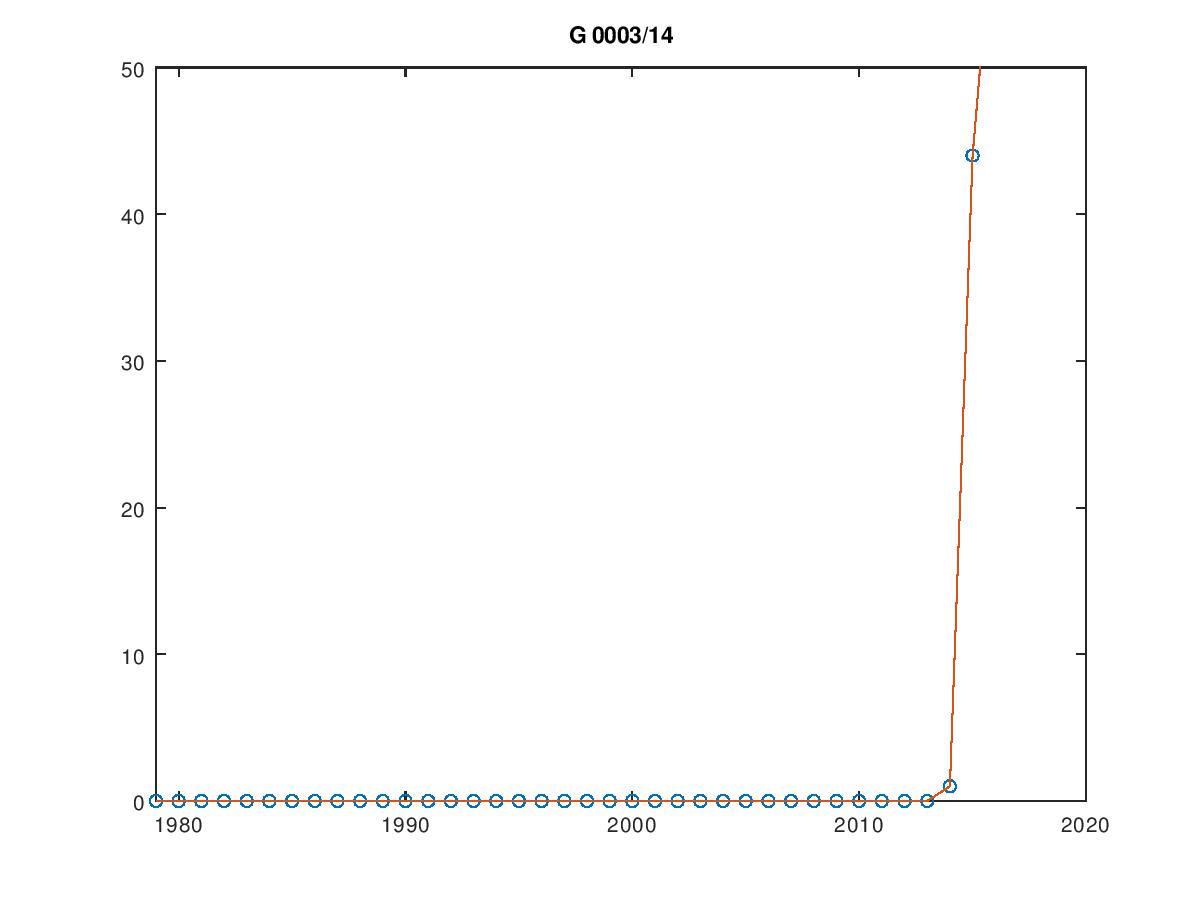
G 3/14 ranks #16 on the list of the 100 most-cited Boards of Appeal decisions of all times, but it is certainly record-holder in terms of citations per year! (see graph right/above)

The decision is concerned with the question of how the requirement of the EPC that a claim should be clear, concise and supported by the description (Art. 84 EPC) is to be treated in opposition and opposition-appeal.

The question arises from the fact that Art. 100 EPC limits the available grounds of opposition to the ones listed in that Article (and Art. 84 is not among them), but Art. 101(3)(b) on the other hand states an opposition must revoke a patent which has been amended in opposition and no longer "meets the requirements of [the EPC]".

The case law concerning the question was divergent. Some Boards were of the opinion that clarity objections against amended claims are to be examined in opposition only to the extent that the clarity objections result from the amendment(s) (e.g., T 301/87). Other Boards, starting with T 1459/05, allowed opposition divisions more flexibility. In the most flexible approach, the power of an opposition division to examine clarity objections against amended claims was unrestricted.

In deciding the questions referred to it, the Enlarged Board considered the wording of Art. 101(3) EPC, which - in relation to amended patents - refers to "the requirements of this Convention" and not only to the grounds of oppositions mentioned in Art. 100 EPC. The fact that the grounds available for opposition are deliberately limited by the EPC to the ones listed in Art. 100(a), (b) and (c) was also taken into account.

After a detailed analysis of the earlier case law and of the text of the EPC, the Enlarged Board came to the conclusion that under Art. 100 and 101(3) EPC, the power of Opposition Divisions (and of Appeal Boards) to examine amended claims under clarity is limited to cases where, and to the extent that, the clarity objections arise from the amendment(s).

Under this concept, e.g., when an opposed patent is amended by inclusion of the features of a dependent claim into the independent claim, a clarity issue, which already existed in the unamended dependent claim, cannot be examined by the Opposition Division.

---

Headnote:
In considering whether, for the purposes of Article 101(3) EPC, a patent as amended meets the requirements of the EPC, the claims of the patent may be examined for compliance with the requirements of Article 84 EPC only when, and then only to the extent that the amendment introduces non-compliance with Article 84 EPC.
The full text of the decision can be found here.

Monday, 5 November 2018

G 0007/93 - Review of first-instance discretionary decisions ("Late amendments") - #18

Citation rank: 18
No. of citations: 173

G 7/93 is primarily concerned with two provisions of the EPC1973, both of which no longer exist under the EPC2000. G 7/93 looked at the question whether late amendments may be allowed by an examining division after formal approval of the text proposed for grant under an old version of Rule 51(4) and (6) EPC1973. A second part of G 7/93 deals with "Reservations" of contracting states under Art. 167 EPC1973, which also no longer exist.

Given that G 7/93 deals with provisions that no longer exist under the EPC2000, it is surprising to see a steep increase in citations of G 7/93 after the EPC2000 came into force (see graph at top right).

It turns out that G 7/93 is nowadays no longer cited for its comments on Rule 51 and Art. 167 EPC1973. Instead, the decision is cited for its general comments on how the EPO's first instance departments are to exercise their "discretion"- if they have it - and to what extent an Appeal Board can review the discretionary decisions of the first instance.

In this context, the Enlarged Board in G 7/93 stated:
"It may be added that if an Examining Division has exercised its discretion [to allow or not to allow further amendments after formal approval was given by applicant to the text proposed for grant] under Rule 86(3) EPC against an applicant in a particular case and the applicant files an appeal against the way in which such discretion was exercised, it is not the function of a Board of Appeal to review all the facts and circumstances of the case as if it were in the place of the first instance department, in order to decide whether or not it would have exercised such discretion in the same way as the first instance department. If a first instance department is required under the EPC to exercise its discretion in certain circumstances, such a department should have a certain degree of freedom when exercising that discretion, without interference from the Boards of Appeal. In the circumstances of a case such as that before the referring Board, a Board of Appeal should only overrule the way in which a first instance department has exercised its discretion if it comes to the conclusion either that the first instance department in its decision has not exercised its discretion in accordance with the right principles as set out in paragraph 2.5 above, or that it has exercised its discretion in an unreasonable way, and has thus exceeded the proper limits of its discretion." (point 2.6 of the reasons)
Following this statement by the Enlarged Board of Appeal, the Appeal Boards nowadays only review discretionary decisions of first-instance departments to the extent that it is assessed whether the deciding body exercised its discretion "in accordance with the right principles, or in an unreasonable way". A Board of Appeal should only overrule the way in which a first instance department has exercised its discretion if it comes to the conclusion either that the first instance department in its decision has not exercised its discretion in accordance with the right principles or that it has exercised its discretion in an unreasonable way (see, e.g., T 2355/09, citing G 7/93).

Most discretionary decisions of the first-instance departments reviewed by the Boards in this manner are decisions on whether or not to allow late-filed requests, documents and/or new grounds in opposition proceedings. Such discretionary decisions are reviewed by Boards of Appeal only to the limited extent described above.

---

Headnote:
1. An approval of a notified text submitted by an applicant pursuant to Rule 51(4) EPC does not become binding once a communication in accordance with Rule 51(6) EPC has been issued. Following issue of such a communication under Rule 51(6) EPC and until issue of a decision to grant the patent, the Examining Division has a discretion under Rule 86(3), second sentence, EPC, whether or not to allow amendment of the application.
2. When exercising such discretion following issue of a communication under Rule 51(6) EPC, an Examining Division must consider all relevant factors. In particular it must consider and balance the applicant's interest in obtaining a patent which is legally valid in all of the designated States, and the EPO's interest in bringing the examination procedure to a close by the issue of a decision to grant the patent. Having regard to the object underlying the issue of a communication under Rule 51(6) EPC, which is to conclude the granting procedure on the basis of the previously approved text, the allowance of a request for amendment at that late stage in the granting procedure will be an exception rather than the rule.
3.Reservations under Article 167(2) EPC do not constitute requirements of the EPC which have to be met according to Article 96(2) EPC.
The full text of the decision can be found here.

Quotes from decisions citing G 7/93 can be found here.

Tuesday, 30 October 2018

T 0073/84 - Revocation by the patent proprietor - #20

Citation rank: 20
No. of citations: 162

It is not foreseen in opposition and opposition-appeals procedures that the patentee requests revocation of his own patent. For example, such an outcome is not among the possible outcomes of an opposition division listed in Art. 101(2) and (3). The possibility for the proprietor of a European patent to request revocation of its own patent was only added to the EPC2000 through the limitation or revocation procedure according to Art. 105a-105c.

In the opposition case underlying T 73/84, the Opposition Division had rejected the opposition and the patent was maintained unamended. The opponent appealed against this decision. At that stage, the patent proprietor referred to Legal Advice No. 11/82 (OJ (EPO) 2/1982, p. 57) and stated that, in order to terminate the appeal proceedings, he no longer approved the text in which the patent was granted and would not be submitting an amended text. Legal Advice 11/82 stated that in opposition proceedings, if  the applicant states that he no longer approves the text in which the patent was granted and does not submit an amended text, the patent must be revoked.

The Board noted with respect to the same situation in appeal proceedings that:
3. Since the text of the patent is at the disposition of the patent proprietor, a patent cannot be maintained against the proprietor's will. If the patent proprietor withdraws his approval, expressed before the first instance, of the text of the patent as granted and declares that he will not be submitting an amended text, it may be inferred that he wishes to prevent any text whatever of the patent from being maintained.
4. However, the patent proprietor cannot terminate the proceedings by telling the EPO that he is surrendering the European Patent, since this is not provided for in the Convention. Thus he would only be able, as far as national law permitted, to surrender the patent vis-à-vis the national patent offices of the designated Contracting States under the relevant national law.
5. At the same time, the proceedings ought to be terminated as quickly as possible in the interests of legal certainty, which calls for a clarification of the industrial rights situation. The only possibility in such a case is to revoke the patent, as envisaged for other reasons in Article 102 EPC. The practice followed by the Opposition Divisions is thus confirmed.
Since then, withdrawal by the proprietor of his consent to the currently pending text (or texts) in appeal proceedings is used to terminate the appeal proceedings by revocation of the patent.

---

Headnote:
If the proprietor of a European patent states in opposition or appeal proceedings that he no longer approves the text in which the patent was granted and will not be submitting an amended text, the patent is to be revoked.
The full text of the decision can be found here.

See T 186/84 on the same issue in opposition proceedings.

Thursday, 25 October 2018

G 0001/99 - Reformatio in peius - #22

Citation rank: 22
No. of citations: 161

Further to G 4/93 (and G 9/92), G 1/99 also looks at the consequences of the principle of party disposition, namely the prohibition of reformatio in peius, in opposition-appeal proceedings where the Opposition Division has upheld the patent in amended form.

G 4/93 held that in such cases, if the proprietor is the sole appellant, neither the Board nor the non-appealing opponent may challenge the maintenance of the patent in amended form (G 4/93, Headnote I)

In the case where the opponent is the sole appellant, G 4/93 held that the proprietor is primarily restricted to defending the patent in the form in which it was maintained by the Opposition Division. Amendments proposed by the patent proprietor, however, may be rejected as inadmissible by the Board "if they are neither appropriate nor necessary" (G 4/93, Headnote II; see here for a brief summary of G 4/93).

G 1/99 now takes a closer look at the latter situation, where the opponent is the sole appellant. In particular, G 1/99 explains how the expression "... if they are neither appropriate nor necessary" in Headnote II of G 4/93 is to be understood.

The Enlarged Board in G 1/99 generally confirmed that the principle of party disposition, and thus the prohibition of reformtio in peius, applies under the EPC (see point 8 of the reasons). However, the principle is not to be applied unconditionally. They stated:
"... Taking into consideration that in appeal proceedings before the EPO the application of the principle of prohibition of reformatio in peius derives from its own case law, the Enlarged Board of Appeal has also to weigh the consequences of this application, if it appears that they might be unsatisfactory." (point 11 of the reasons)
They considered that in the case where the opponent is the sole appellant against a decision of the Opposition Division to maintain the patent in amended form, it would be inappropriate not to allow the proprietor to amend his claims, if such amendment is necessary to undo an Art. 123(2) violation, which occurred during the opposition procedure, and which was allowed by the Opposition Division. Such amendments are to be allowed, even if it meant that the opponent and sole appellant is put is a worse situation than if he had not appealed, i.e., even if the opponent is thereby hit by reformatio in peius. In such situations, reformatio in peius was exceptionally allowed.

The Enlarged Board, however, did not allow any type of amendment. In order to restrict the negative effect of the amendment on the opponent to a minimum, the Enlarged Board held that in such a case, the proprietor may, in this order,
  1. amend the claims by introducing one or more originally disclosed features which limit the scope of the patent as maintained (in this situation the opponent and sole appellant does not suffer from reformatio in peius);
  2. If this is not possible, amend the claims by introducing one or more originally disclosed features which extend the scope of the patent as maintained, but of course not extending beyond the scope of the patent as granted (Art. 123(3) (here reformatio in peius occurs);
  3. If amendments under 1 and 2 are not possible, the proprietor may delete the feature which led to the Art. 123(2) infringement, but within the limits of Article 123(3) EPC (here reformatio in peius is even worse).
Generally, the prohibition of reformatio in peius is more strictly applied in cases where the proprietor is the sole appellant, as compared to where the opponent is the sole appellant. The Enlarged Board considered this "un-symmetrical" application of the principle of reformatio in peius justified, i.a., because a losing opponent has further opportunity to invalidate the European patent in national invalidity proceedings, whereas a proprietor, who's patent is revoked in opposition/appeal proceedings before the EPO, has lost its patent for good.

---

Headnote:
In principle, an amended claim, which would put the opponent and sole appellant in a worse situation than if it had not appealed, must be rejected. However, an exception to this principle may be made in order to meet an objection put forward by the opponent/appellant or the Board during the appeal proceedings, in circumstances where the patent as maintained in amended form would otherwise have to be revoked as a direct consequence of an inadmissible amendment held allowable by the Opposition Division in its interlocutory decision.
In such circumstances, in order to overcome the deficiency, the patent proprietor/respondent may be allowed to file requests, as follows:
- in the first place, for an amendment introducing one or more originally disclosed features which limit the scope of the patent as maintained;
- if such a limitation is not possible, for an amendment introducing one or more originally disclosed features which extend the scope of the patent as maintained, but within the limits of Article 123(3) EPC;
- finally, if such amendments are not possible, for deletion of the inadmissible amendment, but within the limits of Article 123(3) EPC.
The full text of the decision can be found here.

Quotes from decisions citing G 1/99 can be found here.

Tuesday, 23 October 2018

G 0004/93 - "Non-appealing party" - #23

Citation rank: 23
No. of citations: 146

G 4/93 (in consolidated proceedings with G 9/92, see same review here) looked at the consequences of the "principle of party disposition" on inter partes opposition-appeal proceedings.

Two Boards of Appeal referred questions to the Enlarged Board of Appeal under Art. 112(1)(a) EPC. The questions arose from three appeal cases, all of which were concerned with an appeal against the decision of an oppositon division to maintain the patent in amended form according to Art. 101(3)(a) EPC. In one case the proprietor was the sole appellant, in another case only the opponent appealed. In the third case both parties appealed.

The Technical Boards referred the question whether a Board of Appeal, in proceedings before it, could put the sole appellant in a worse position than if it had not appealed, or whether there should be prohibition of reformatio in peius (Latin: "change for the worse"). Specifically, they asked the Enlarged Board:
"Can the Board of Appeal amend a contested decision to the Appellant's disadvantage? -   If so, to what extent?"
The Enlarged Board pointed out that the proceedings before the EPO are generally goverened by the principle of party disposition, i.e., that the parties define the extent of the proceedings through their intial requests. This principle is also known as the principle of "ne ultra petita" (Latin: "not beyond the request").

The Enlarged Board mentioned that decisions G 9/91 and G 10/91 already clarified that the principle of party disposition applies to opposition and opposition-appeal proceedings before the EPO (see G 4/93, points 3 and 4 of the reasons). The principle of ex officio examination (Art. 114(1) EPC), on the other hand, found little application in appeal proceedings (points 4 and 5 of the reasons).

Under the principle of party disposition, in opposition-appeal cases in which the patent is maintained in amended form, the appeal of the proprietor, who is the sole appellant, can only be understood as a request of the proprietor-appellant to maintain its patent in unamended form, or at least with a scope somewhere between that of the patent upheld in opposition and the scope as granted. In any case, the proprietor's appeal cannot be interpreted as being a request to further limit the appellant's patent. Therefore, the Enlarged Board in G 4/93 found that it would be against the principle of party disposition to limit a patent to less than the scope maintained in opposition, if the proprietor is the sole appellant (see Headnote I).

Where the opponent is the sole appellant, the situation is the opposite. It would be against the principle of party disposition, if an Appeal Board broadened the scope of the patent (e.g., maintained the patent as granted). This would certainly be against the opponent/sole appellant's initial request. The proprietor is thus primarily restricted to defending the patent in the form in which it was maintained by the Opposition Division (see Headnote II).

If both, the proprietor and the opponent, appeal against the decision to uphold the patent in amended form, the principle of party disposition clearly can no longer be fully observed. This is impossible, because of the parties' initial requests are contradicting. In this situation, an Appeal Board is free to broaden or lessen the scope of the patent as mainteined by the opposition division all the way from maintenance as granted to revocation in full.

Remark: G 1/99 ("Reformatio in peius") later took a closer look at the situation in which the opponent is the sole appellant (Headnote II, below). G 1/99 exceptionally allowed broadening of the scope of the claims (beyond the scope of the claims maintained in opposition, but within the limits of Art. 123(3)) in the case where the proprietor would otherwise lose its patent because of a Art. 123(2) infringement which occurred during the opposition stage. The cautious wording "may be rejected as inadmissible by the Board of Appeal if they are neither appropriate nor necessary" in Headnote II, below, was thus interpreted as as allowing certain exceptions. See here for a brief summary of G 1/99.
---

Headnote:
I. If the patent proprietor is the sole appellant against an interlocutory decision maintaining a patent in amended form, neither the Board of Appeal nor the non-appealing opponent as a party to the proceedings as of right under Article 107, second sentence, EPC, may challenge the maintenance of the patent as amended in accordance with the interlocutory decision.
II. If the opponent is the sole appellant against an interlocutory decision maintaining a patent in amended form, the patent proprietor is primarily restricted during the appeal proceedings to defending the patent in the form in which it was maintained by the Opposition Division in its interlocutory decision. Amendments proposed by the patent proprietor as a party to the proceedings as of right under Article 107, second sentence, EPC, may be rejected as inadmissible by the Board of Appeal if they are neither appropriate nor necessary.
The full text of the decision can be found here.

Friday, 31 August 2018

G 0008/91 - Withdrawal of the appeal - #52

Citation rank: 52
No. of citations: 88

G 7/91 and G 8/91, in consolidated proceedings, looked  at the consequences of the withdrawal of the sole appeal (or of all appeals) in the ongoing appeal proceedings.

In the underlying opposition case T 357/89 the European patent had been maintained in amended form. The sole opponent appealed against this decision, requesting that it be set aside and the patent revoked. The respondents (patent proprietors) reacted by filing new claims. The appellant then withdrew its appeal.

The referring Technical Board in T 357/89 thought that a decision of the Enlarged Board was required as to whether appeal proceedings can be continued, if the sole appeal (or all appeals) have been withdraw.

That question had not yet been clarified by case law. Prior to G 8/91, Board members usually would merely note the fact that the appeal has been withdrawn, and the parties are informed by the Registry that the appeal proceedings have been terminated accordingly. Special forms were available for such situations (EPO Forms 3312, 3347, 3348).This practice was now under review.

The Enlarged Board generally considered that it was undesirable to change long-standing practices in the proceedings before the EPO, for reasons of continuity (point 4 of the reasons).

The existing practice was also in line with the principle of party disposition, according to which a public authority or a court normally may not continue proceedings if the procedural act which gave rise to the proceedings (such as the filing of an appeal) has been retracted (point 5 of the reasons).

The Enlarged Board further considered Rule 60(2) EPC1973 (now R. 84 EPC), according to which opposition proceedings can be continued in case of legal incapacity or death of the opponent. This, however, was seen as an exception.

Also the principle of ex officio examination (Art. 114 EPC) was looked at. A situation was envisaged, in which the appeal was withdrawn, and a Board of Appeals had to "stand by and watch" while the "flawed" decision (i.e., a "flawed patent") entered into force because of the withdrawal. The question arose of whether, in such cases, the public must be protected. The Enlarged Board of Appeals, however, found that the public interest (against "flawed" patents) was adequately served by the principle that any person is free to file an opposition against such patents (point 10.1 of the reasons).

In summary, the Enlarged Board saw no convincing reasons for abandoning or changing the then current practice of the Boards of Appeal according to which, in as far as the substantive issues of the appeal are concerned, the appeal proceedings are terminated by virtue of the withdrawal of the sole appellant's appeal, whether in ex parte or in inter partes proceedings. Hence, the Enlaged Board decided in favour of that current practice.

It decided that, in so far as the substantive issues settled by the contested decision at first instance are concerned, appeal proceedings are terminated, in ex parte and inter partes proceedings alike, when the sole appellant withdraws the appeal

Remark: G 8/93 later looked at the situation where the opponent and sole appellant withdraws his opposition during appeal proceedings. Also in this case the appeal proceedings are automatically terminated, with not possibility for the Board to continue. G 8/93 did not make it into the top-100 of most cited Boards of Appeal decisions. The text of G 8/93, however, can be found here.

---

Headnote:
In so far as the substantive issues settled by the contested decision at first instance are concerned, appeal proceedings are terminated, in ex parte and inter partes proceedings alike, when the sole appellant withdraws the appeal.
The full text of the decision can be found here.

Thursday, 16 August 2018

G 0001/86 - Re-establishment of rights of opponent - #63

Citation rank: 63
No. of citations: 78


Re-establishment of rights (also referred to as restitutio in integrum) is a legal remedy, which allows the applicant or proprietor to be re-instated in his rights, which he/she lost due to non-observance of a time limit in spite of "all due care" required under the circumstances having been taken. The remedy is based on Art. 122 EPC which expressly states that it is available for the "applicant for or proprietor of a European patent".

In the underlying appeal case, an opponent had filed an appeal against the opposition division’s interlocutory decision with which the patent was upheld in amended form. However, he failed to submit the Grounds of Appeal within the 4-month time limit of Art. 108 EPC. Admissibility of his appeal was thus at risk. The opponent filed the Grounds of Appeal after expiry of the 4 month time limit together with a request for re-establishment of rights.

The competent Technical Board of Appeals realised that the requester (opponent) was not the "applicant for or proprietor of the European patent”, as required by Art. 122, but it seemed unfair if the legal remedy of Art. 122 was not available to the appellant-opponent in this case. It referred the following question to the Enlarged Board of Appeals:
“Can an appellant as opponent have his rights re-established under Article 122 EPC if he has failed to observe the time limit specified in Article 108, 3rd sentence, EPC for filing the statement of grounds of appeal?”
The Enlarged Board observed that a loss of rights for failure to observe a time limit was particularly harsh when person who missed the time limit was not actually at fault and the failure was attributable to an oversight which occurred in spite of all due care required by the circumstances having been taken (point 1 of the reasons).

Regarding the question, whether Art. 122 EPC was applicable to persons other than the applicant or proprietor, the Enlarged Board stated:
"In the view of the Enlarged Board of Appeal [the first sentence of Art. 122 EPC] must not be interpreted as excluding a priori all other persons not expressly referred to in Article 122(1) EPC from re-establishment of rights, as this would clearly have inequitable and logically unjustifiable consequences. Other parties who are not applicants or patent proprietors may also through no fault of their own fail to observe a time limit in proceedings before the EPO and as a result run the risk of an irrevocable loss of rights. These include, for example, professional representatives before the EPO (Article 20 EPC), inventors (Rule 19 EPC) and persons who, although not applicants, are entitled to a European patent (Article 61 EPC). It is not clear on what grounds these persons should be excluded from re-establishment of rights." (point 3 of the reasons)
Based on the historical documentation relating to the EPC ("traveaux préparatoires"), the principle of equal treatment of parties, and taking the legislators original intent into account, it decided that Art. 122 EPC was also applicable to the appellent-opponent who failed to observe the 4 moth time limit for filing the Grounds of Appeal.

---

Headnote:
Article 122 EPC is not to be interpreted as being applicable only to the applicant and patent proprietor. An appellant as opponent may have his rights re-established under Article 122 EPC if he has failed to observe the time limit for filing the statement of grounds of appeal.
The full text of the decision (in three languages) can be found here.

Friday, 10 August 2018

T 0095/83 - Late-filed requests - #75

Citation rank: 75
No. of citations: 65

T 95/83 is one of the very early appeal cases in which  the question of late filing of requests was addressed. In the underlying opposition-appeal, the proprietor filed a second auxiliary request only at the beginning of the oral proceedings. The opponent requested that the second auxiliary request should not be admitted, or at least the oral proceedings should be postponed.

The Board observed that requests should be filed at the earliest possible moment and that admittance of requests filed as late as at the beginning of oral proceedings would only happen in very exceptional cases.

In the case at hand, the late-filed request was not admitted.

---

Headnote:
If an applicant for a patent or a patentee desires to submit amendments to the description, claims or drawings of a European patent application or a European patent in the course of appeal proceedings, this should be done at the earliest possible moment (OJ EPO 6/1981, 176; 8/1984, 376). It is only in the most exceptional circumstances, where there is some clear justification both for the amendment and for its late submission, that it is likely that an amendment not submitted in good time before oral proceedings will be considered on its merits in those proceedings by a Board of Appeal.
The full text of the decision can be accessed here.

Saturday, 21 July 2018

T 0326/87 - Late filing of evidence in opposition/appeal results in apportionment of costs - #83

Citation rank: 83
No. of citations: 61
 
T 326/87 was frequently cited in the years from its publication in 1990 to 2008. Then, it seems to have run out of fashion. It was not cited by other Boards from 2009 onwards.

The reasons for the loss of popularity are not immediately apparent. It deals with an issue of ever-increasing relevance: late filing of evidence in opposition/appeal proceedings. T 326/87 is still referred to in the introductory portion of the chapter on late-filing in opposition/appeal proceedings in the EPO Case Law Book (ed. 2016, IV.C.1.3).

In the opposition case underlying T 326/87 the opposition was initially rejected. One of the opponents/appellant filed - together with its Grounds of Appeal - a further prior art document in support of its inventive step arguments. The Board considered whether such late-filed evidence should be admitted into the procedure.

The Board stressed that parties to oppositon and appeal procedures have a general duty to present evidence at an early stage in the procedure. Boards and Opposition Divisions have the discretion not to admit late-filed evidence (reasons 2.1.2; Art. 114(2) EPC).

The Board stated that, if a late-filed document is sufficiently relevant for it to be admitted into the procedure, the case should normally be remitted - together with the new document - to the first instance (reasons 2.2).

The Board further held that the party that filed the evidence late should normally bear the additional costs incurred as a result of the late-filing, both its own costs and any additional cost incurred by the other party/parties (reasons 2.3).

In the specific case, the Board admitted the relevant late-filed document into the procedure. It found that the excuse presented by the opponent/appellant for filing the document late (the late-filed document being a patent document from the former GDR, and at the time not normally present in the available "manual search stock") was credible and acceptable. The Board nevertheless ordered that the opponent bears (only) 50% of the patentee's costs for the oral proceedings in appeal.

---

Headnote:
1. The public's as well as the parties' interests require that opposition proceedings should be speedily concluded. This requirement clearly extends to appeal proceedings as well. Article 99(1) and Rule 55(c) EPC, read in the light of Rule 66 EPC, seek to ensure this by requiring the full presentation in the Notice of Opposition of the case that a patentee needs to meet in order to keep his patent in force (see paragraph 2.1.1 of the Reasons for the Decision).
2. Matter, e.g. facts and evidence, submitted for the first time in appeal proceedings may be disregarded by the Boards of Appeal as a matter of discretion and pursuant to Article 114(2) EPC, which sets the legal limit upon the inquisitorial duties of the Board under Article 114(1) EPC (see paragraph 2.1.2 of the Reasons for the Decision).
3. If the evidential weight of late-filed documents in relation to those already in the case ("their relevance") warrants their admission into the proceedings, the case should normally be remitted to the first instance (Article 111(1) EPC), particularly if the late-filed material puts the maintenance of the patent at risk (see paragraph 2.2 of the Reasons for the Decision).
4. In such a case, costs between the parties should be apportioned under Article 104 and Rule 63(1) EPC, in such a way that the late-filing party should normally bear all the additional costs caused by his tardiness (see paragraph 2.3 of the Reasons for the Decision).
5. Costs should only be shared between the parties if there exist strong mitigating circumstances for the late filing of facts, evidence or other matter (see final sentence of paragraph 2.3 and paragraph 5 of the Reasons for the Decision).
The text of the decision is available here.

Thursday, 12 July 2018

T 0063/86 (Consent for amendments) of 10.8.1987 - #90

Rank: 90
No. of citations: 58

T 63/86 deals with the appeal procedure. It is concerned with the question to what extent are amendments to the claims allowed together with the Notice or Grounds of Appeal.

In the case at hand notice of appeal was filed together with a new set of Claims 1 to 16, which were described as "replacing all claims on file". The new claim 1 did not appear to correspond to any particular combination of the claims previously filed.

The Board noted that the applicant/appellant did no longer wish to pursue the claims that led to the refusal . Regarding the question whether or not to admit such amendments at the appeal stage, the Board stated:
"[A]mendment of the claims of an application at the [...] stage of examination is a matter of discretion governed by the final sentence of Rule 86(3) EPC [now: R. 137(3) EPC], which states "No further amendment may be made without the consent of the Examining Division", that is, no further amendment without such consent after the opportunity to amend in reply to the first communication of the Examining Division has passed. Thus, the fact that an appeal has been filed does not give the patent proprietor any right to amend his application as part of the appeal proceedings."
The Board thus found that a Board is not obliged to admit further amendments. They noted that Art.111(1)  EPC1973 allowed them to "exercise any power within the competence of the department which was responsible for the decision appealed". They did not, however, go so far to not admit the claims and to thereby end the procedure. Instead they stated:
"In cases of minor amendments filed during the appeal, it may be appropriate for a Board of Appeal to exercise the discretion of the Examining Division under Rule 86(3) EPC [now: R. 137(3) EPC]. However, in a case such as the present, where substantial amendments have been proposed which require a substantial further examination in relation to both the formal and substantive requirements of the EPC, such further examination should be carried out, if at all, by the Examining Division as the first instance, only after the Examining Division has itself exercised its discretion under Rule 86(3) EPC. In this way, the applicant's right to appeal to a second instance is maintained, both in relation to the exercise of discretion under Rule 86(3) EPC, and (if such discretion is favourably exercised) in relation to the formal and substantive allowability of the amended claims." (point 2 of the reasons) 
Finally, the Board concluded that the case is to be remitted to the first instance to decide (i) whether the further amendments to the claims can be made under Rule 86(3) EPC1973 [R. 137(3) EPC]; and (ii) if such amendments can be made, whether such claims are allowable.


T 63/86 represents a rather liberal policy of the Boards towards late amendments to the claims. It seems as if an increased workload/pressure on the Boards has changed their policy towards late-filed amendments. Nowadays, late-filed claims are often simply not admitted. This may be a reason why T 63/86 has not been used or cited by other Boards from 2014 onwards.

---

Headnote 1 and 2:
1. The amendment of claims during an appeal from a decision to refuse a European patent application is a matter of discretion under Rule 86(3) EPC, final sentence.
2. In a case where substantial amendments to the claims are proposed on appeal, which require substantial further examination, the case should be remitted to the Examining Division, so that such examination should be carried out, if at all, by the Examining Division after the latter has exercised its discretion under Rule 86(3) EPC, final sentence.

The full text of the decision can be found here.