Showing posts with label grounds for opposition. Show all posts

Saturday, 29 December 2018

G 0010/91 - Examination of opposition-appeals - #2

Citation rank: 2
No. of citations: 665

G 10/91 (in consolidated proceedings with G 9/01) is concerned with the character and nature of the opposition and opposition-appeal proceedings. Both G decisions defined powers of Opposition Divisions and Appeal Boards to examine the case. While G 9/91 was concerned with the question of which parts (i.e., which claims) of the contested patent may be examined, G 10/91 looked at the Grounds of Opposition, as provided in Art. 100(a)-(c) EPC, which may be considered by the Opposition Division or Board.

In the underlying case leading to the referral (T 580/89), only certain claims of the opposed patent were actually opposed (namely, under Art. 100(a) EPC). Other claims were not attacked. Also, no other Grounds of Opposition than Art. 100(a) was raised. Upon appeal, however, the opponent then also raised objections against the originally non-attacked claims. Furthermore, in the course of the appeal proceedings a third party filed observations under Art. 115 EPC, submitting that the subject-matter relating to all claims was not patentable due to lack of novelty and inventive step.

In this situation the the question arose whether the originally non-attacked claims may be examined by the Board, despite the fact that the original opposition did not concern these claims. The Board found that this the question was an important point of law within the meaning of Article 112(1)(a) EPC. It thus referred the following questions to the Enlarged Board of Appeal (reference number G 9/91):
1. Is the power of an Opposition Division or, by reason of Rule 66(1) EPC, of a Board of Appeal to examine and decide on the maintenance of a European patent under Articles 101 and 102 EPC dependent upon the extent to which the patent is opposed in the notice of opposition pursuant to Rule 55(c) EPC?
2. If the answer to the first question should be affirmative, are there any exceptions to such dependence?
At that stage, the President of the EPO, making use of his power under Article 112(1)(b) EPC, referred the following question to the Enlarged Board of Appeal (reference number G 10/91):
Is the Opposition Division in the examination of the opposition obliged to consider all the grounds for opposition referred to in Article 100 EPC or is this examination restricted to the grounds referred to by the opponent in his statement of grounds of opposition?
The Enlarged Board of Appeal considered that the questions referred by the Technical Board and by the President concerned related issues, and should therefore be treated in consolidated proceedings. Hence, the Facts and Submissions, as well as the Reasons for the Decision in G 9/91 and G 10/91 are the same. The orders of the respective decisions, however, relate to the specific questions referred to the Enlarged Board in the respective case.

In deciding case G 10/91, the Enlarged Board first noted that the questions referred to in G 9/91 and G 10/91 were, although related, in fact rather different: The question of which parts of the patent can be examined (G 9/91) concerned the formal competence of the Opposition Division/Appeal Boards to examine, whereas the question referred in G 10/91 related to the procedural principles applicable in the respective procedures (point 12 of the reasons).

Regarding the question which Grounds for Opposition may be examined (G 10/91), the case law was divergent. For example, in T 493/88 it was held that Art. 101 and 102 EPC1973 (now Art. 101 EPC) clearly referred to all Grounds for Opposition and does not limit the scope of examination by the Opposition Division. T 182/89, on the other hand, held that Art. 114 EPC (ex officio examination) should not be interpreted as requiring an Opposition Division or Appeal Board to examine Grounds of Opposition that were not raised by opponents within the 9 months opposition time limit.

The Enlarged Board found that the approach taken in T 182/89 was more in line with the concept of post-grant opposition proceedings, as present under the EPC. They also mentioned "procedural expediency" as a positive side effect (point 14 of the reasons). Ultimately, they decided that Opposition Divisions and Appeal Boards were not required to examine Grounds of Opposition not raised in the Notice of Oppostion.

A crucial point to be decided was, however, whether an Opposition Division/Board may examine such Grounds, i.e., whether Art. 114(1) EPC empowers an Opposition Division or Appeal Board to examine Grounds for Opposion not raised in the Notice of Opposition.

In this regard, the Enlarged Board noted that it was common practice before the EPC that the principle of ex officio examination also applied in opposition proceedings (point 16 of the reasons). This was also refleted in the traveaux preparatoires (BR 87/71, point 9). The Enlarged Board found that there was no reason to change the established practice. The current practice helped avoiding maintenance of patents in opposition which were invalid.

The Enlarged Board thus stated:
"[A]n Opposition Division may, in application of Article 114(1) EPC, of its own motion raise a ground for opposition not covered by the statement pursuant to Rule 55(c) EPC or consider such a ground raised by the opponent (or referred to by a third party under Article 115 EPC) after the expiry of the time limit laid down in Article 99 (1) EPC. At the same time, the Enlarged Board would like to emphasise that the consideration of grounds not properly covered by the statement pursuant to Rule 55(c) EPC, as an exception to the principle established by the Board in paragraph 6 above, should only take place before the Opposition Division in cases where, prima facie, there are clear reasons to believe that such grounds are relevant and would in whole or in part prejudice the maintenance of the European patent." (point 16 of the reasons)
In appeal proceedings, this did not apply. The Enlarged Board stated that appeal proceedings were a judicial review procedure and thus less investigative by nature. Therefore, Art. 114(1) EPC (ex officio examination) should be applied in a more restrictive manner. Grounds of Opposition not raised in the initial Notice of Oppostion may not be examined by Appeal Boards. The Enlarged Board allowed one exception, however: "volenti non fit injuria" (latin: "to a willing person, injury is not done"). Hence, fresh Grounds may be examined by a Board in appeal proceedings, if the proprietor agrees. Otherwise, if the patentee does not agree to the introduction of a fresh ground for opposition, such a ground may not be dealt with in substance in the decision of the Board of Appeal at all. Only the fact that the question has been raised may be mentioned (point 18 of the reasons).

Finally, the Enlarged Board confirmed that the above restrictions to the examination of Grounds for Opposition only apply to the claims as granted. Any amendment introduced during the opposition or appeal proceedings must be fully examined as to its compatibility with the requirements of the EPC, e.g., also with regard to the provisions of Article 123(2) and (3) EPC (point 19 of the reasons).

Remark: See G 3/14 for examination of clarity objections in opposition and opposition-appeal proceedings. A brief summary of G 3/14 can be found here.

---

Headnote:
1. An Opposition Division or a Board of Appeal is not obliged to consider all the grounds for opposition referred to in Article 100 EPC, going beyond the grounds covered by the statement under Rule 55(c) EPC.
2. In principle, the Opposition Division shall examine only such grounds for opposition which have been properly submitted and substantiated in accordance with Article 99(1) in conjunction with Rule 55(c) EPC. Exceptionally, the Opposition Division may in application of Article 114(1) EPC consider other grounds for opposition which, prima facie, in whole or in part would seem to prejudice the maintenance of the European patent.
3. Fresh grounds for opposition may be considered in appeal proceedings only with the approval of the patentee.
The full text of G 10/91 can be found here.

Quotes from 10 decisions citing G 10/91 can be found here.

Tuesday, 13 November 2018

T 0301/87 - Clarity in opposition proceedings (pre-G 3/14) - #15

Citation rank: 15
No. of citations: 191

T 301/87 is one of many decisions concerned with the question of whether and to what extent clarity objections can be examined in opposition. It represents one of two "diverging" schools of case law, which were considered by the Enlarged Board of Appeal when they looked at the same question in G 3/14. G 3/14 ultimately followed the approach taken by T 301/87, i.e., that clarity objections are to be examined only if the clarity objections arise out of the amendments made during opposition. (G 3/14 added an additional restriction to the examination of clarity objections in opposition, namely that the clarity objection can only be examined to the extent that the clarity objection arises from the amendment.)

Consideration was given in T 301/87 (and G 3/14) to the fact that, on the one hand, clarity is not included in the (exhaustive) list of grounds for opposition of Art. 100 EPC, but Art. 101(3) requires that the opposition division considers whether the amended patent "meets the requirements of [the EPC]" (with no reference to Art. 100 EPC).

T 301/87 appears still valid after publication of G 3/14, but G 3/14 of course carries more weight and is nowadays the decision to be cited. G 3/14 (rank #16 in the list of most-cited Board of Appeal decisions) has recently been summarised in this blog here.

---

Headnote:
1. When amendments are made to a patent during an opposition, Article 102(3) EPC requires consideration as to whether the amendments introduce any contravention of any requirement of the Convention, including Article 84 EPC; Article 102(3) EPC does not allow objections to be based upon Article 84 EPC, if such objections do not arise out of the amendments made (further to T 227/88, dated 15 December 1988) (cf. Point 3.7 of the reasons)
[...]

 The full text of the decision can be found here.

Friday, 9 November 2018

G 0003/14 - Clarity in oppostion proceedings - #16

Citation rank: 16
No. of citations: 186

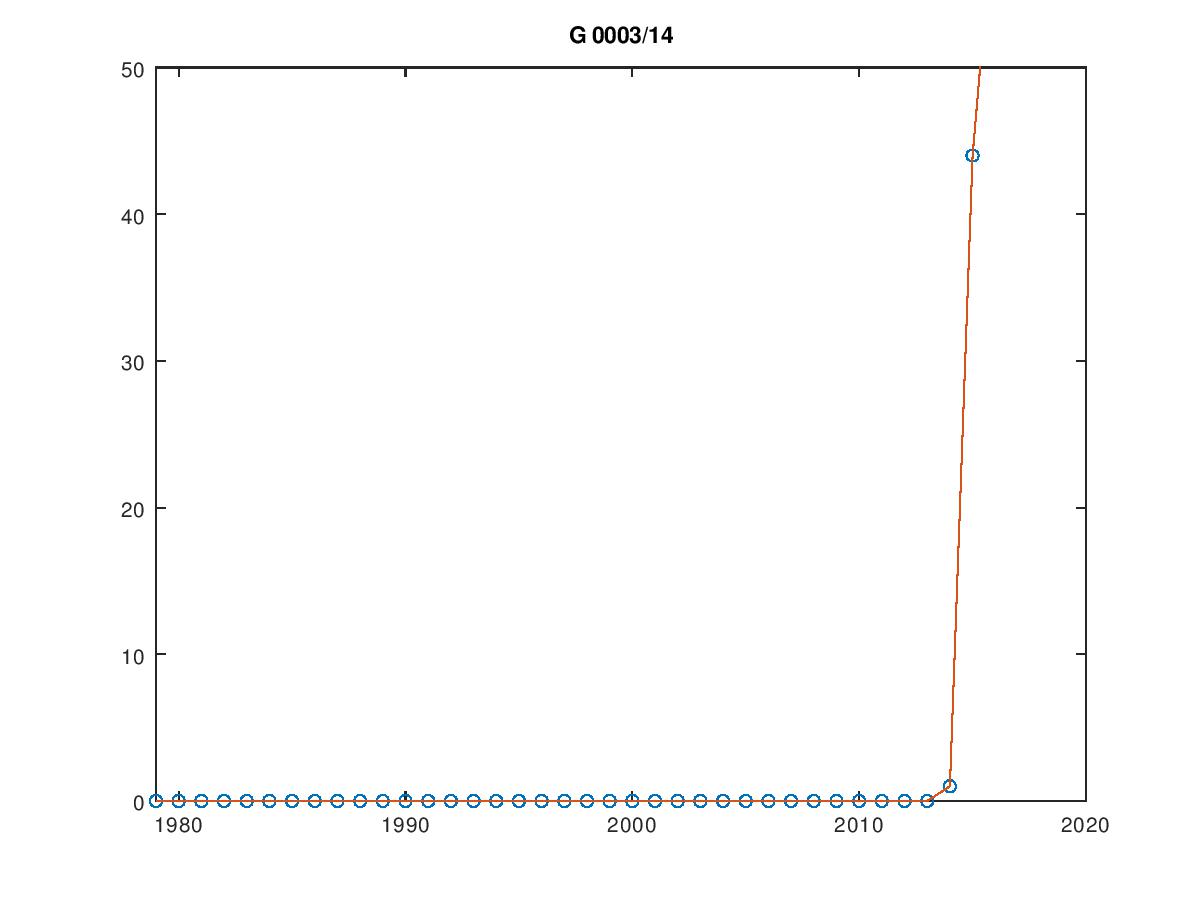
G 3/14 ranks #16 on the list of the 100 most-cited Boards of Appeal decisions of all times, but it is certainly record-holder in terms of citations per year! (see graph right/above)

The decision is concerned with the question of how the requirement of the EPC that a claim should be clear, concise and supported by the description (Art. 84 EPC) is to be treated in opposition and opposition-appeal.

The question arises from the fact that Art. 100 EPC limits the available grounds of opposition to the ones listed in that Article (and Art. 84 is not among them), but Art. 101(3)(b) on the other hand states an opposition must revoke a patent which has been amended in opposition and no longer "meets the requirements of [the EPC]".

The case law concerning the question was divergent. Some Boards were of the opinion that clarity objections against amended claims are to be examined in opposition only to the extent that the clarity objections result from the amendment(s) (e.g., T 301/87). Other Boards, starting with T 1459/05, allowed opposition divisions more flexibility. In the most flexible approach, the power of an opposition division to examine clarity objections against amended claims was unrestricted.

In deciding the questions referred to it, the Enlarged Board considered the wording of Art. 101(3) EPC, which - in relation to amended patents - refers to "the requirements of this Convention" and not only to the grounds of oppositions mentioned in Art. 100 EPC. The fact that the grounds available for opposition are deliberately limited by the EPC to the ones listed in Art. 100(a), (b) and (c) was also taken into account.

After a detailed analysis of the earlier case law and of the text of the EPC, the Enlarged Board came to the conclusion that under Art. 100 and 101(3) EPC, the power of Opposition Divisions (and of Appeal Boards) to examine amended claims under clarity is limited to cases where, and to the extent that, the clarity objections arise from the amendment(s).

Under this concept, e.g., when an opposed patent is amended by inclusion of the features of a dependent claim into the independent claim, a clarity issue, which already existed in the unamended dependent claim, cannot be examined by the Opposition Division.

---

Headnote:
In considering whether, for the purposes of Article 101(3) EPC, a patent as amended meets the requirements of the EPC, the claims of the patent may be examined for compliance with the requirements of Article 84 EPC only when, and then only to the extent that the amendment introduces non-compliance with Article 84 EPC.
The full text of the decision can be found here.

Monday, 8 October 2018

G 0007/95 - Fresh grounds for opposition - #29

Citation rank: 29
No. of citations: 128

G 7/95 (and G 1/95) are concerned with the expression "grounds for opposition" ("motifs d’opposition", "Einspruchsgründe") and its meaning in the context of Art. 100 EPC.

Art. 100 EPC specifies the grounds under which a European patent can be opposed, namely:
"Art. 100 EPC - Opposition may only be filed on the grounds that:
   (a) the subject-matter of the European patent is not patentable under Articles 52 to 57;
   (b) the European patent does not disclose the invention in a manner sufficiently clear and complete for it to be carried out by a person skilled in the art;
   (c) the subject-matter of the European patent extends beyond the content of the application as filed, or, if the patent was granted on a divisional application or on a new application filed under Article 61, beyond the content of the earlier application as filed."
As background, G 10/91 held that, in principle, the Opposition Division shall examine only such grounds for opposition, which have been properly submitted and substantiated in the notice of opposition. Only exceptionally, the Opposition Division may consider other grounds ("fresh grounds") for opposition, which, prima facie, in whole or in part would seem to prejudice the maintenance of the European patent. Regarding the appeal proceedings, G 10/91 held that fresh grounds for opposition may be considered in appeal proceedings only with the approval of the patentee.

In the case underlying G 7/95, the opponent had initially attacked the patent only under inventive step. In appeal, the opponent-appellant then alleged lack of novelty over the closest prior art document previously used under inventive step.

The question thus arose whether an alleged lack of novelty is a "fresh ground" of opposition over the previously raised ground of lack of inventive step. If answered to the affirmative, a Board of Appeals could not examine the fresh ground without the consent of the proprietor (G 10/91). The answer is also not self-evident, because - after all - lack of novelty and lack of inventive step are both mentioned in the same paragraph/section of Art. 100, viz., Art. 100(a). Previous case law regarding that question had been divergent. The  corresponding question was thus referred to the Enlarged Board.

The Enlarged Board looked at the structure of Art. 100 (and of the related Art. 138 EPC). They stated that, while Art. 100(b) and (c) each related to a "single, separate and clearly delimited legal basis on which an opposition can be based" (4.2 of the resons), the same was not true for Art. 100(a). Art. 100(a). They stated:
4.3 Indeed, Article 100(a) EPC simply refers, apart from the general definition of patentable inventions according to Article 52(1) EPC, and the exceptions to patentability according to Article 53 EPC, to a number of definitions according to Articles 52(2) to (4) and 54 to 57 EPC, which specify "invention", "novelty", "inventive step" and "industrial application" which, when used together with Article 52(1) EPC, define specific requirements and therefore form separate grounds for opposition in the sense of separate legal objections or bases for opposition.
The ground of lack of novelty was thus seen as being separate and therefore "fresh" in view of the original ground of lack of inventive step. Therefore, following G 10/91, an appeal board could thus not examine this fresh ground as such.

However, the Enlarged Board observed that where is no novelty, there can also be no inventive step. Specifically, they stated:
7.2 Nevertheless, in a case such as that under consideration in the decision of referral in case G 7/95, if the closest prior art document destroys the novelty of the claimed subject- matter, such subject-matter obviously cannot involve an inventive step. Therefore, a finding of lack of novelty in such circumstances inevitably results in such subject-matter being unallowable on the ground of lack of inventive step.
Hence, although the ground of "lack of novelty" cannot be examined by a Board under that title, the Board can still use the same facts under the "lack of inventive step" title. 

The related G 1/95 was concerned with the question of whether the ground that claimed subject-matter is not an invention within the meaning of Article 52(1), (2) EPC is a "fresh ground" lack of novelty and inventive step. For the same reasons as G 7/95, the question was answered to the affirmative.

---

Headnote:
In a case where a patent has been opposed under Article 100(a) EPC on the ground that the claims lack an inventive step in view of documents cited in the notice of opposition, the ground of lack of novelty based upon Articles 52(1) and 54 EPC is a fresh ground for opposition and accordingly may not be introduced into the appeal proceedings without the agreement of the patentee. However, the allegation that the claims lack novelty in view of the closest prior art document may be considered in the context of deciding upon the ground of lack of inventive step.
The order of the decision can be found here. The reasons are the ones of G 1/95, which can be found here.

Quotes from decisions citing G 7/95 can be found here.

Thursday, 9 August 2018

T 0222/85 - Notice of opposition must be sufficiently reasoned - #68

Citation rank: 68
No. of citations: 73

T 222/85 dealt the question of admissibility of an opposition, in particular the question how well the Grounds of Opposition must be explained in the Notice in order to comply with the requirement nowadays stated in Rule 76(2)(c) (then Rule 55(c) EPC1973) that the Notice is to contain "a statement of the extent to which the European patent is opposed and of the grounds on which the opposition is based, as well as an indication of the facts and evidence presented in support of these grounds".

The Board held that this requirement was only
satisfied if the contents of the notice of opposition were sufficient for the opponent's case
to be properly understood. The purpose of the requirement, in combination with the first two requirements of Rule 76(2), was to put the patentee and the opposition division in a situation where they knew what that case was about. They pointed out that, whereas the requirements of Rules 76(1) (a "written reasoned statement"), 76(2)(a) ("particulars of the opponent") and (b) ("number of the European patent") are merely formal in nature, the requirement of R. 76(2)(c) is a substantive requirement, which called for sufficient reasoning. A well-drafted opposition ought to contain reasoning that was full but concise. In general, the less reasoning that a notice of opposition contained, the greater the risk that it would be rejected as inadmissible.

The Board summarised the contents of the Notice of Opposition as follows:
' The notice of opposition sets out the following, under the heading "grounds": "The subject-matter of EP-5033, as defined in Claims 1 to 21 covers polyesters, coating compositions and paint compositions as currently described in the state of the art and/or applied in the field of art. The hydroxyl value, items (a) and (b), optional items (c) and (d), the weight percentages of cyclic moieties plus amide moieties, and the weight percentages of reactants with a functionality of 3 or more, as stated in Claim 1 of patent No. 5033 are quite conventional and generally known from the state of the art as represented by (for instance):" and there then followed a list of 16 prior published patent specifications. There then follows three paragraphs which allege that the feature of "high molecular weights" is an obvious aim, that methods of reaching high molecular weights are commonly known as disclosed for instance at two identified pages of a textbook, and that "according to opponent's measurements many known polyesters satisfy" the new parameter definition of molecular weight used in the opposed patent. Finally, it stated: "The polyesters, coating compositions and paint compositions as claimed in EP-5033 thus lack any novelty or inventive step, and are therefore not patentable in view of the articles of the EPC, in particular Articles 54 and 56." ' (point II of the Facts and Submission)
These Grounds were regarded insufficient and the opposition was held inadmissible. The corresponding appeal was thus rejected.

---

Headnote 2:
2. The requirement under Rule 55(c) EPC [now R. 76(2)(c) EPC], that the notice of opposition shall, inter alia, contain "an indication of facts, evidence and arguments presented in support of the ground" is only satisfied if the contents of such notice are sufficient for the opponent's case to be properly understood on an objective basis.
The full text of the decision can be found here.