Wednesday, 14 November 2018

T 0939/92 - Technical effect "over the whole area claimed" - Triazoles/AGREVO - #14

Citation rank: 14
No. of citations: 198

T 939/92 ("AGREVO") looked at the relationship between the contribution to the art and scope of claims and its bearing on the assessment of inventive step.

Claim 1 in the underlying examination case related to broadly defined triazole compounds. It was asserted by the applicant that the claimed triazole compounds had herbicidal activity. The Examining Division had refused the application for lack of support (Art. 84). In particular, they were of the opinion that the scope of the claims did not represent a reasonable generalisation of the examples provided in the description.

Also the Appeal Board found that the claims were unreasonably broad. They also questioned that the application documents contained sufficient internal evidence to render it credible that all claimed compounds would have the stated herbicidal activity. They also agreed with the Examining Division that the claim feature defining a residue "R3" as "optionally substituted phenyl" meant that the phenyl of R3 could be "substituted by absolutely anything" (point 6 of the decision under appeal).

While the Examining Division concluded that the claim lacked support (Art. 84), the Board stated that it does not follow from Article 84 EPC that a claim is objectionable simply because it is "unreasonably broad" (cf. Headnote I). The Board found that the claim was supported by the description, but saw problems regarding inventive step. In this context, they stated:
"2.4.2 The reason for this is that it has for long been a generally accepted legal principle that the extent of the patent monopoly should correspond to and be justified by the technical contribution to the art (see T 409/91, OJ EPO 1994, 653 , reasons Nos. 3.3. and 3.4, and T 435/91, OJ EPO 1995, 188, reasons Nos. 2.2.1 and 2.2.2). Now, whereas in both the above decisions this general legal principle was applied in relation to the extent of the patent protection that was justified by reference to the requirements of Articles 83 and 84 EPC, the same legal principle also governs the decision that is required to be made under Article 56 EPC, for everything falling within a valid claim has to be inventive. If this is not the case, the claim must be amended so as to exclude obvious subject-matter in order to justify the monopoly."
In the case of the triazole compounds of claim 1, the applicant could only demonstrate herbicidal activity of some of the compounds falling under claim 1. In all of those compounds for which herbicidal activity was shown, R3 was a phenyl substituted by halogen atoms or methyl groups. On the basis of this evidence, the Board was not satisfied that substantially all compounds now being claimed are likely to be herbicidally active (point 2.7 of the reasons).

The Board concluded that, because it was not demonstrated that the technical effect, on which the invention relied, existed over the whole area claimed, claim 1 lacked inventive step. (This reasoning is now often used by opponents in chemical opposition cases, and commonly referred to as the "Agrevo" argument.)

---

Headnote:
1. If a claim concerns a group of chemical compounds per se, an objection of lack of support by the description pursuant to Article 84 EPC cannot properly be raised for the sole reason that the description does not contain sufficient information in order to make it credible that an alleged technical effect (which is not, however, a part of the definition of the claimed compounds) is obtained by all the compounds claimed (see Reasons No. 2.2.2).
2. The question as to whether or not such a technical effect is achieved by all the chemical compounds covered by such a claim may properly arise under Article 56 EPC, if this technical effect turns out to be the sole reason for the alleged inventiveness of these compounds (Reasons Nos. 2.4 to 2.6).
The full text of the decision can be accessed here

Tuesday, 13 November 2018

T 0301/87 - Clarity in opposition proceedings (pre-G 3/14) - #15

Citation rank: 15
No. of citations: 191

T 301/87 is one of many decisions concerned with the question of whether and to what extent clarity objections can be examined in opposition. It represents one of two "diverging" schools of case law, which were considered by the Enlarged Board of Appeal when they looked at the same question in G 3/14. G 3/14 ultimately followed the approach taken by T 301/87, i.e., that clarity objections are to be examined only if the clarity objections arise out of the amendments made during opposition. (G 3/14 added an additional restriction to the examination of clarity objections in opposition, namely that the clarity objection can only be examined to the extent that the clarity objection arises from the amendment.)

Consideration was given in T 301/87 (and G 3/14) to the fact that, on the one hand, clarity is not included in the (exhaustive) list of grounds for opposition of Art. 100 EPC, but Art. 101(3) requires that the opposition division considers whether the amended patent "meets the requirements of [the EPC]" (with no reference to Art. 100 EPC).

T 301/87 appears still valid after publication of G 3/14, but G 3/14 of course carries more weight and is nowadays the decision to be cited. G 3/14 (rank #16 in the list of most-cited Board of Appeal decisions) has recently been summarised in this blog here.

---

Headnote:
1. When amendments are made to a patent during an opposition, Article 102(3) EPC requires consideration as to whether the amendments introduce any contravention of any requirement of the Convention, including Article 84 EPC; Article 102(3) EPC does not allow objections to be based upon Article 84 EPC, if such objections do not arise out of the amendments made (further to T 227/88, dated 15 December 1988) (cf. Point 3.7 of the reasons)
[...]

 The full text of the decision can be found here.

Friday, 9 November 2018

G 0003/14 - Clarity in oppostion proceedings - #16

Citation rank: 16
No. of citations: 186

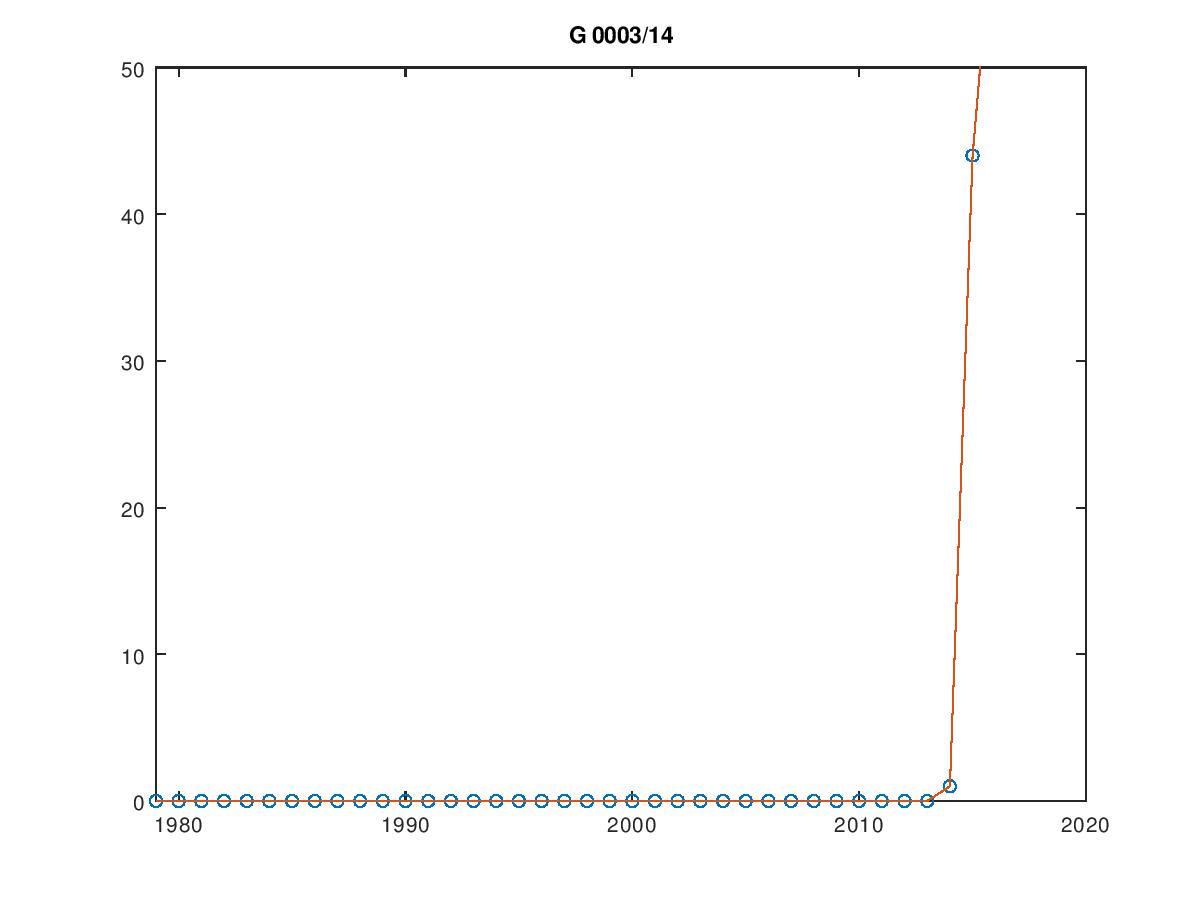
G 3/14 ranks #16 on the list of the 100 most-cited Boards of Appeal decisions of all times, but it is certainly record-holder in terms of citations per year! (see graph right/above)

The decision is concerned with the question of how the requirement of the EPC that a claim should be clear, concise and supported by the description (Art. 84 EPC) is to be treated in opposition and opposition-appeal.

The question arises from the fact that Art. 100 EPC limits the available grounds of opposition to the ones listed in that Article (and Art. 84 is not among them), but Art. 101(3)(b) on the other hand states an opposition must revoke a patent which has been amended in opposition and no longer "meets the requirements of [the EPC]".

The case law concerning the question was divergent. Some Boards were of the opinion that clarity objections against amended claims are to be examined in opposition only to the extent that the clarity objections result from the amendment(s) (e.g., T 301/87). Other Boards, starting with T 1459/05, allowed opposition divisions more flexibility. In the most flexible approach, the power of an opposition division to examine clarity objections against amended claims was unrestricted.

In deciding the questions referred to it, the Enlarged Board considered the wording of Art. 101(3) EPC, which - in relation to amended patents - refers to "the requirements of this Convention" and not only to the grounds of oppositions mentioned in Art. 100 EPC. The fact that the grounds available for opposition are deliberately limited by the EPC to the ones listed in Art. 100(a), (b) and (c) was also taken into account.

After a detailed analysis of the earlier case law and of the text of the EPC, the Enlarged Board came to the conclusion that under Art. 100 and 101(3) EPC, the power of Opposition Divisions (and of Appeal Boards) to examine amended claims under clarity is limited to cases where, and to the extent that, the clarity objections arise from the amendment(s).

Under this concept, e.g., when an opposed patent is amended by inclusion of the features of a dependent claim into the independent claim, a clarity issue, which already existed in the unamended dependent claim, cannot be examined by the Opposition Division.

---

Headnote:
In considering whether, for the purposes of Article 101(3) EPC, a patent as amended meets the requirements of the EPC, the claims of the patent may be examined for compliance with the requirements of Article 84 EPC only when, and then only to the extent that the amendment introduces non-compliance with Article 84 EPC.
The full text of the decision can be found here.

Tuesday, 6 November 2018

T 0219/83 - Burden of proof / Benefit of doubt - #17

Citation rank: 17
No. of citations: 174

T 219/83 is concerned with issues of proof. In particular, T 219/83 looks at a situation where parties to opposition-appeal proceedings make contrary assertions, and the Board is unable to establish which party is right.

Claim 1 of the contested patent related to a process for the manufacture of a zeolite from silicon dioxide and metal oxides, characterized (i.a.) in that the crystallization is carried out in the absence of an alkali metal. Claim 4 related to zeolites produced by the process of claim 1.

Regarding the product-by-process claim 4, the proprietor asserted that at the time of filing the patent application, no methods were available to produce zeolites having as low an alkali content as obtained by the claimed process. The claimed product would thus be new. They drew attention to their own unsuccessful attempts to remove residual alkali from known zeolites with a higher alkali content by repeated ion exchange.

The opponents, on the other hand, stated the opposite: they asserted that available methods were able to produce zeolites of a low alkali content, as claimed. Although they disputed the contention that there was no way of removing the residual alkali they had not been able to indicate a specific method suited to this purpose, or even to suggest the bare outlines of such a method.

The Board noted that they themselves were unable to establish whether or not such methods existed. They stated in this regard:
"It is true that under Article 114(1) EPC the European Patent Office, in proceedings before it, examines the facts of its own motion and is not restricted in this examination to the facts, evidence and arguments provided by the parties and the relief sought. But if the European Patent Office is unable to establish the facts of its own motion, it is the party whose argument rests on these alleged facts who loses thereby. This is the situation here. The two parties have made contrary assertions concerning the desired elimination of alkali. In such cases the ruling goes against the opponent as appellant if he is unable to substantiate an assertion which could disprove the existence of an inventive step. It was up to the opponents to name a method in the state of the art whereby it was possible prior to the filing date to prepare by other means zeolites free of alkali to the same degree as those in the patent in question. The opponents were unable to name any such method; nor is the Board aware of one. Accordingly, the opponents' assertion can only be treated as an unproven supposition which cannot counter the assumption that the granted European patent involves an inventive step." (point 12 of the reasons)
In other words, the burden of proof for the assertion that prior art methods were unable to produce zeolites with a low alkali content thus lay with the opponents. They did not provide the necessary proof, thus, the benefit of doubt had to be given to the patentee.

The patent was thus maintained (in slightly amended form).

Remark: I have no good explanation why the number of citations dropped significantly around 2007. At least Headnote I (see below) seems equally valid under the EPC1973 and today. The decision is also still cited in the Case Law Book (2016, chapter III.G.5.1.1).

---

Headnote:
I. If the parties to opposition proceedings make contrary assertions which they cannot substantiate and the European Patent Office is unable to establish the facts of its own motion, the patent proprietor is given the benefit of the doubt.

2. After oral appeal proceedings in connection with an opposition, the parties must be informed and invited to state their observations concerning the maintenance of the European patent in the amended form within a period of one month in accordance with Rule 58(4) EPC only, if they cannot reasonably be expected to do so definitively during the oral proceedings.
The full text of the decision can be found here.

Quotes from decisions citing T 219/83 can be found here.

Monday, 5 November 2018

G 0007/93 - Review of first-instance discretionary decisions ("Late amendments") - #18

Citation rank: 18
No. of citations: 173

G 7/93 is primarily concerned with two provisions of the EPC1973, both of which no longer exist under the EPC2000. G 7/93 looked at the question whether late amendments may be allowed by an examining division after formal approval of the text proposed for grant under an old version of Rule 51(4) and (6) EPC1973. A second part of G 7/93 deals with "Reservations" of contracting states under Art. 167 EPC1973, which also no longer exist.

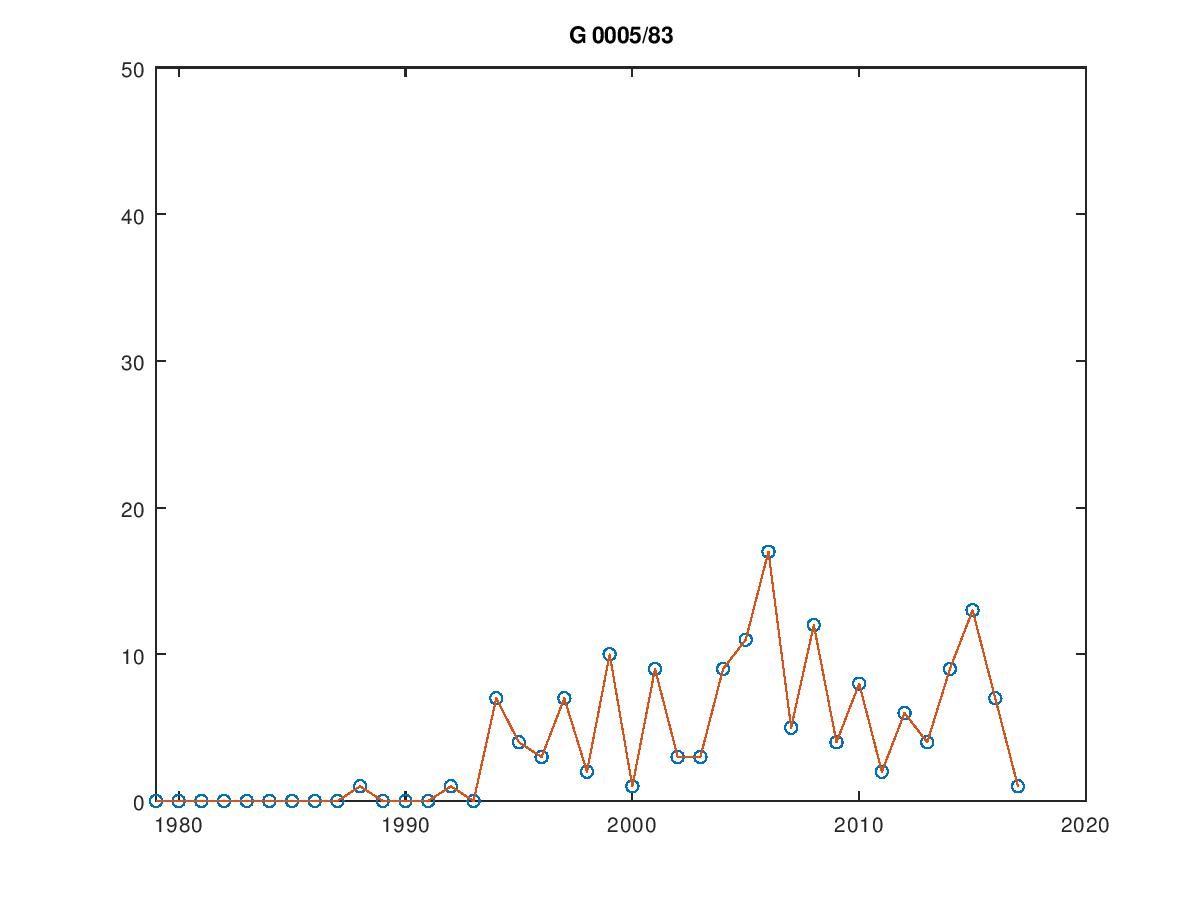
Given that G 7/93 deals with provisions that no longer exist under the EPC2000, it is surprising to see a steep increase in citations of G 7/93 after the EPC2000 came into force (see graph at top right).

It turns out that G 7/93 is nowadays no longer cited for its comments on Rule 51 and Art. 167 EPC1973. Instead, the decision is cited for its general comments on how the EPO's first instance departments are to exercise their "discretion"- if they have it - and to what extent an Appeal Board can review the discretionary decisions of the first instance.

In this context, the Enlarged Board in G 7/93 stated:
"It may be added that if an Examining Division has exercised its discretion [to allow or not to allow further amendments after formal approval was given by applicant to the text proposed for grant] under Rule 86(3) EPC against an applicant in a particular case and the applicant files an appeal against the way in which such discretion was exercised, it is not the function of a Board of Appeal to review all the facts and circumstances of the case as if it were in the place of the first instance department, in order to decide whether or not it would have exercised such discretion in the same way as the first instance department. If a first instance department is required under the EPC to exercise its discretion in certain circumstances, such a department should have a certain degree of freedom when exercising that discretion, without interference from the Boards of Appeal. In the circumstances of a case such as that before the referring Board, a Board of Appeal should only overrule the way in which a first instance department has exercised its discretion if it comes to the conclusion either that the first instance department in its decision has not exercised its discretion in accordance with the right principles as set out in paragraph 2.5 above, or that it has exercised its discretion in an unreasonable way, and has thus exceeded the proper limits of its discretion." (point 2.6 of the reasons)
Following this statement by the Enlarged Board of Appeal, the Appeal Boards nowadays only review discretionary decisions of first-instance departments to the extent that it is assessed whether the deciding body exercised its discretion "in accordance with the right principles, or in an unreasonable way". A Board of Appeal should only overrule the way in which a first instance department has exercised its discretion if it comes to the conclusion either that the first instance department in its decision has not exercised its discretion in accordance with the right principles or that it has exercised its discretion in an unreasonable way (see, e.g., T 2355/09, citing G 7/93).

Most discretionary decisions of the first-instance departments reviewed by the Boards in this manner are decisions on whether or not to allow late-filed requests, documents and/or new grounds in opposition proceedings. Such discretionary decisions are reviewed by Boards of Appeal only to the limited extent described above.

---

Headnote:
1. An approval of a notified text submitted by an applicant pursuant to Rule 51(4) EPC does not become binding once a communication in accordance with Rule 51(6) EPC has been issued. Following issue of such a communication under Rule 51(6) EPC and until issue of a decision to grant the patent, the Examining Division has a discretion under Rule 86(3), second sentence, EPC, whether or not to allow amendment of the application.
2. When exercising such discretion following issue of a communication under Rule 51(6) EPC, an Examining Division must consider all relevant factors. In particular it must consider and balance the applicant's interest in obtaining a patent which is legally valid in all of the designated States, and the EPO's interest in bringing the examination procedure to a close by the issue of a decision to grant the patent. Having regard to the object underlying the issue of a communication under Rule 51(6) EPC, which is to conclude the granting procedure on the basis of the previously approved text, the allowance of a request for amendment at that late stage in the granting procedure will be an exception rather than the rule.
3.Reservations under Article 167(2) EPC do not constitute requirements of the EPC which have to be met according to Article 96(2) EPC.
The full text of the decision can be found here.

Quotes from decisions citing G 7/93 can be found here.

Friday, 2 November 2018

G 0004/92 - Basis of decisions / Right to be heard - #19

Citation rank: 19
No. of citations: 166

G 4/92 is concerned with the question of whether or not a decision against a party which is absent from the oral proceedings can be announced at the end of the oral proceedings, if the decision is based on facts and evidence, such as documents, presented for the first time during the oral proceedings.

The case law regarding this question had been divergent:

Decision T 574/89 held that by choosing to stay away from oral proceedings the parties "had forfeited their right to present comments", and hence that "any arguments or evidence submitted by the parties present at oral proceedings" could "be used as a basis for the decision without it being relevant whether such evidence or arguments were already known to the absent parties from the written submissions or whether they could expect such evidence or arguments to be presented".

T 484/90, on the other hand, held that "a decision against a party duly summoned to but failing to appear at oral proceedings which is based on new evidence, such as a new document, on which that party has not had the opportunity to comment, may not be pronounced at the close of those proceedings without infringing that party's right to be heard, unless the absent party indicates that it is forfeiting this right".

When considering the answer to the question, the Enlarged Board firstly considered that the right to be heard, as implemented by Art. 113(1) EPC, was a fundamental right of parties to proceedings before the EPO (point 2 of the reasons).

The Enlarged Board secondly considered Rule 71(2) EPC1973 (now R. 115(2) EPC), which states that, if a party who has been duly summoned to oral proceedings does not appear as summoned, the proceedings may continue without the party. The Enlarged Board considered that no party should be allowed to delay the issue of a decision by failing to appear at the oral proceedings (point 4 of the reasons).

Thirdly, the Enlarged Board considered that a party should not wait until oral proceedings before presenting new facts or evidence that could have been submitted earlier. This would constitute an abuse of procedure which should be sanctioned by disregarding such matter in accordance with Article 114(2) EPC (point 7 of the reasons).

In weighing the above considerations the Enlarged Board came to the conclusion that a decision may be taken during oral proceedings, also in the absence of a duly summoned party, if the decision is not based on facts put forward for the first time during oral proceedings. The latter would infringe the absent party's right to be heard (Art. 113(1) EPC).

New arguments presented for the first time at oral proceedings were seen less critical. A decision could based on such new arguments, because arguments are not "grounds or evidence" as recited in Art. 113 EPC. Arguments are merely reasons based on the "facts and evidence " which have already been put forward (point 10 of the reasons).

---

Headnote:
1. A decision against a party who has been duly summoned but who fails to appear at oral proceedings may not be based on facts put forward for the first time during those oral proceedings.
2. Similarly, new evidence may not be considered unless it has been previously notified and it merely supports the assertions of the party who submits it, whereas new arguments may in principle be used to support the reasons for the decision.
The full text of the decision can be accessed here.

 Quotes from decisions citing G 4/92 can be found here.

Tuesday, 30 October 2018

T 0073/84 - Revocation by the patent proprietor - #20

Citation rank: 20
No. of citations: 162

It is not foreseen in opposition and opposition-appeals procedures that the patentee requests revocation of his own patent. For example, such an outcome is not among the possible outcomes of an opposition division listed in Art. 101(2) and (3). The possibility for the proprietor of a European patent to request revocation of its own patent was only added to the EPC2000 through the limitation or revocation procedure according to Art. 105a-105c.

In the opposition case underlying T 73/84, the Opposition Division had rejected the opposition and the patent was maintained unamended. The opponent appealed against this decision. At that stage, the patent proprietor referred to Legal Advice No. 11/82 (OJ (EPO) 2/1982, p. 57) and stated that, in order to terminate the appeal proceedings, he no longer approved the text in which the patent was granted and would not be submitting an amended text. Legal Advice 11/82 stated that in opposition proceedings, if  the applicant states that he no longer approves the text in which the patent was granted and does not submit an amended text, the patent must be revoked.

The Board noted with respect to the same situation in appeal proceedings that:
3. Since the text of the patent is at the disposition of the patent proprietor, a patent cannot be maintained against the proprietor's will. If the patent proprietor withdraws his approval, expressed before the first instance, of the text of the patent as granted and declares that he will not be submitting an amended text, it may be inferred that he wishes to prevent any text whatever of the patent from being maintained.
4. However, the patent proprietor cannot terminate the proceedings by telling the EPO that he is surrendering the European Patent, since this is not provided for in the Convention. Thus he would only be able, as far as national law permitted, to surrender the patent vis-à-vis the national patent offices of the designated Contracting States under the relevant national law.
5. At the same time, the proceedings ought to be terminated as quickly as possible in the interests of legal certainty, which calls for a clarification of the industrial rights situation. The only possibility in such a case is to revoke the patent, as envisaged for other reasons in Article 102 EPC. The practice followed by the Opposition Divisions is thus confirmed.
Since then, withdrawal by the proprietor of his consent to the currently pending text (or texts) in appeal proceedings is used to terminate the appeal proceedings by revocation of the patent.

---

Headnote:
If the proprietor of a European patent states in opposition or appeal proceedings that he no longer approves the text in which the patent was granted and will not be submitting an amended text, the patent is to be revoked.
The full text of the decision can be found here.

See T 186/84 on the same issue in opposition proceedings.

G 0005/83 - Second medical indication - #21

Citation rank: 21
No. of citations: 162

G 5/83 is one of seven(!) parallel cases before the Enlarged Board of Appeals, all dealing with the question of whether or how inventions relating to a "second medical indication" of a chemical compound or composition can be protected under the EPC. These seven decisions were also the very first decisions delivered by Enlarged Board of Appeal.

At the time of G 5/83 there was (and still is today) considerable interest in protecting inventions relating to the "second medical use" or "second medical indication" of chemical entities, i.e., where the compounds or compositions were already known to be useful as medicaments, but for a different disease/in a different indication. The difficulty was that Art. 52(4) EPC1973 in did not allow claims to "methods for treatment of the human or animal body by therapy". More specifically, Art. 52(4) EPC1973 stipulated that such methods were not susceptible of industrial application, one of the three basic patentability requirements. (The exclusion from patentability of therpeutic methods is still present in the EPC2000, but it is implemented in a different manner, namely it is formulated as an "exception to patentability" under Art. 53(c) EPC.)

The German High Court ("Bundesgerichtshof", BGH) had already decided that, under German national law, the subject-matter of a claim directed to the use of a chemical substance to treat an illness extends beyond the treatment of the illness, namely to the preparation for use ("augenfällige Herrichtung"), which, according to the BGH, includes at least the packaging of the substance with instructions for use in the treatment of the illness. A claim directed to the use of a compound to treat an illness could therefore be used in German national law to protect the "second (or further) medical indication".

The Enlarged Board, however, did not agree with the findings of the BGH. In particular, the Enlarged Board found that there was in principle no difference between a method claim and a use claim; it was merely a matter of preference of the applicant whether to formulate a method claim as use claim or vice versa. In this regard, the Enlarged Board stated:
11. The European Patent Convention, in general, allows both method claims and use claims but whether any activity is claimed as a method of carrying out the activity (setting out a sequence of steps) or as the use of a thing for a stated purpose (the sequence of steps being implied), is, in the opinion of the Enlarged Board, a matter of preference. For the European Patent Office there is no difference of substance. In the context of the present case, this means that any artificial distinction according to which, when the invention concerns the employment of a substance or composition for therapy, a method claim excludes and a use claim includes at least the preparation of a pharmaceutical product, with instructions for use in the treatment of illness (which has been called in German the "augenfällige Herrichtung"), cannot be accepted, because in both cases the active substance or composition for therapy must be in a state capable of exerting its therapeutic activity and this necessarily means that the active material has been formulated and made up into doses.
Since a second-medical indication claim in the form of a "use claim" was no different than the corresponding claim formulated as "method claim" (the latter being expressly excluded from patentability), no patent could be granted according to the Enlarged Board on a second-medical use claim irrespective of whether it was formulated as "use" or "method claim":
13. For the reasons already given, in the considered opinion of the Enlarged Board, a claim directed to the "use of a substance or composition for the treatment of the human or animal body by therapy" is in no way different in essential content from a claim directed to "a method of treatment of the human or animal body by therapy with the substance or composition". The difference between the two claims is one of form only and the second form of claim is plainly in conflict with Article 52(4) EPC. Since this is so, no patent can be granted including any such claims: Article 97(1) EPC.
The Enlarged Board, however, recognised that Article 54(5) EPC1973 provided for the possibility to protect inventions based on the "first medical indication" of a compound or composition, namely in the form of a purpose-limited product claim. The Enlarged Board noted that, apparently, no problem arose with respect to susceptibility of industrial application of such an invention, within the meaning of Article 57 EPC. Furthermore, from the Articles and Rules of the EPC1973, as well as from its legislative history, the Enlarged Board concluded that
"[n]o intention to exclude second (and further) medical indications generally from patent protection can be deduced from the terms of the European Patent Convention: nor can it be deduced from the legislative history of the articles in question."  (point 22 or reasons)
The Enlarged Board then considered a statement made by the Swiss Federal Intellectual Property Office, stating that they allowed claims to second-medical use inventions in the form of a use claim directed to the use of a substance or composition for the manufacture of a medicament for a specified (new) therapeutic application (point 19 of the reasons).

The Enlarged Board concluded that it is legitimate to allow claims directed to the use of a substance or composition for the manufacture of a medicament for a specified new and inventive therapeutic application, even in a case in which the process of manufacture as such does not differ from known processes using the same active ingredient (point 23 of the reasons).

That claim format was since then referred to as the "Swiss-type claim". It was the claim format of choice to protect second medical indications under the EPC up until G 2/08 ("Dosage regime"). This decision held that under the new wording of the EPC2000 (which allowed purpose-limited product protection for second medical indications, Art. 54(5) EPC), there was no longer room for second-medical use claims in Swiss-type format. The purpose-limited product claim should be used instead.

---

Headnote:
I. A European Patent with claims directed to the use may not be granted for the use of a substance or composition for the treatment of the human or animal body by therapy.
II. A European patent may be granted with claims directed to the use of a substance or composition for the manufacture of a medicament for a specified new and inventive therapeutic application.
The full text of the decision can be accessed here.

Thursday, 25 October 2018

G 0001/99 - Reformatio in peius - #22

Citation rank: 22
No. of citations: 161

Further to G 4/93 (and G 9/92), G 1/99 also looks at the consequences of the principle of party disposition, namely the prohibition of reformatio in peius, in opposition-appeal proceedings where the Opposition Division has upheld the patent in amended form.

G 4/93 held that in such cases, if the proprietor is the sole appellant, neither the Board nor the non-appealing opponent may challenge the maintenance of the patent in amended form (G 4/93, Headnote I)

In the case where the opponent is the sole appellant, G 4/93 held that the proprietor is primarily restricted to defending the patent in the form in which it was maintained by the Opposition Division. Amendments proposed by the patent proprietor, however, may be rejected as inadmissible by the Board "if they are neither appropriate nor necessary" (G 4/93, Headnote II; see here for a brief summary of G 4/93).

G 1/99 now takes a closer look at the latter situation, where the opponent is the sole appellant. In particular, G 1/99 explains how the expression "... if they are neither appropriate nor necessary" in Headnote II of G 4/93 is to be understood.

The Enlarged Board in G 1/99 generally confirmed that the principle of party disposition, and thus the prohibition of reformtio in peius, applies under the EPC (see point 8 of the reasons). However, the principle is not to be applied unconditionally. They stated:
"... Taking into consideration that in appeal proceedings before the EPO the application of the principle of prohibition of reformatio in peius derives from its own case law, the Enlarged Board of Appeal has also to weigh the consequences of this application, if it appears that they might be unsatisfactory." (point 11 of the reasons)
They considered that in the case where the opponent is the sole appellant against a decision of the Opposition Division to maintain the patent in amended form, it would be inappropriate not to allow the proprietor to amend his claims, if such amendment is necessary to undo an Art. 123(2) violation, which occurred during the opposition procedure, and which was allowed by the Opposition Division. Such amendments are to be allowed, even if it meant that the opponent and sole appellant is put is a worse situation than if he had not appealed, i.e., even if the opponent is thereby hit by reformatio in peius. In such situations, reformatio in peius was exceptionally allowed.

The Enlarged Board, however, did not allow any type of amendment. In order to restrict the negative effect of the amendment on the opponent to a minimum, the Enlarged Board held that in such a case, the proprietor may, in this order,
  1. amend the claims by introducing one or more originally disclosed features which limit the scope of the patent as maintained (in this situation the opponent and sole appellant does not suffer from reformatio in peius);
  2. If this is not possible, amend the claims by introducing one or more originally disclosed features which extend the scope of the patent as maintained, but of course not extending beyond the scope of the patent as granted (Art. 123(3) (here reformatio in peius occurs);
  3. If amendments under 1 and 2 are not possible, the proprietor may delete the feature which led to the Art. 123(2) infringement, but within the limits of Article 123(3) EPC (here reformatio in peius is even worse).
Generally, the prohibition of reformatio in peius is more strictly applied in cases where the proprietor is the sole appellant, as compared to where the opponent is the sole appellant. The Enlarged Board considered this "un-symmetrical" application of the principle of reformatio in peius justified, i.a., because a losing opponent has further opportunity to invalidate the European patent in national invalidity proceedings, whereas a proprietor, who's patent is revoked in opposition/appeal proceedings before the EPO, has lost its patent for good.

---

Headnote:
In principle, an amended claim, which would put the opponent and sole appellant in a worse situation than if it had not appealed, must be rejected. However, an exception to this principle may be made in order to meet an objection put forward by the opponent/appellant or the Board during the appeal proceedings, in circumstances where the patent as maintained in amended form would otherwise have to be revoked as a direct consequence of an inadmissible amendment held allowable by the Opposition Division in its interlocutory decision.
In such circumstances, in order to overcome the deficiency, the patent proprietor/respondent may be allowed to file requests, as follows:
- in the first place, for an amendment introducing one or more originally disclosed features which limit the scope of the patent as maintained;
- if such a limitation is not possible, for an amendment introducing one or more originally disclosed features which extend the scope of the patent as maintained, but within the limits of Article 123(3) EPC;
- finally, if such amendments are not possible, for deletion of the inadmissible amendment, but within the limits of Article 123(3) EPC.
The full text of the decision can be found here.

Quotes from decisions citing G 1/99 can be found here.

Tuesday, 23 October 2018

G 0004/93 - "Non-appealing party" - #23

Citation rank: 23
No. of citations: 146

G 4/93 (in consolidated proceedings with G 9/92, see same review here) looked at the consequences of the "principle of party disposition" on inter partes opposition-appeal proceedings.

Two Boards of Appeal referred questions to the Enlarged Board of Appeal under Art. 112(1)(a) EPC. The questions arose from three appeal cases, all of which were concerned with an appeal against the decision of an oppositon division to maintain the patent in amended form according to Art. 101(3)(a) EPC. In one case the proprietor was the sole appellant, in another case only the opponent appealed. In the third case both parties appealed.

The Technical Boards referred the question whether a Board of Appeal, in proceedings before it, could put the sole appellant in a worse position than if it had not appealed, or whether there should be prohibition of reformatio in peius (Latin: "change for the worse"). Specifically, they asked the Enlarged Board:
"Can the Board of Appeal amend a contested decision to the Appellant's disadvantage? -   If so, to what extent?"
The Enlarged Board pointed out that the proceedings before the EPO are generally goverened by the principle of party disposition, i.e., that the parties define the extent of the proceedings through their intial requests. This principle is also known as the principle of "ne ultra petita" (Latin: "not beyond the request").

The Enlarged Board mentioned that decisions G 9/91 and G 10/91 already clarified that the principle of party disposition applies to opposition and opposition-appeal proceedings before the EPO (see G 4/93, points 3 and 4 of the reasons). The principle of ex officio examination (Art. 114(1) EPC), on the other hand, found little application in appeal proceedings (points 4 and 5 of the reasons).

Under the principle of party disposition, in opposition-appeal cases in which the patent is maintained in amended form, the appeal of the proprietor, who is the sole appellant, can only be understood as a request of the proprietor-appellant to maintain its patent in unamended form, or at least with a scope somewhere between that of the patent upheld in opposition and the scope as granted. In any case, the proprietor's appeal cannot be interpreted as being a request to further limit the appellant's patent. Therefore, the Enlarged Board in G 4/93 found that it would be against the principle of party disposition to limit a patent to less than the scope maintained in opposition, if the proprietor is the sole appellant (see Headnote I).

Where the opponent is the sole appellant, the situation is the opposite. It would be against the principle of party disposition, if an Appeal Board broadened the scope of the patent (e.g., maintained the patent as granted). This would certainly be against the opponent/sole appellant's initial request. The proprietor is thus primarily restricted to defending the patent in the form in which it was maintained by the Opposition Division (see Headnote II).

If both, the proprietor and the opponent, appeal against the decision to uphold the patent in amended form, the principle of party disposition clearly can no longer be fully observed. This is impossible, because of the parties' initial requests are contradicting. In this situation, an Appeal Board is free to broaden or lessen the scope of the patent as mainteined by the opposition division all the way from maintenance as granted to revocation in full.

Remark: G 1/99 ("Reformatio in peius") later took a closer look at the situation in which the opponent is the sole appellant (Headnote II, below). G 1/99 exceptionally allowed broadening of the scope of the claims (beyond the scope of the claims maintained in opposition, but within the limits of Art. 123(3)) in the case where the proprietor would otherwise lose its patent because of a Art. 123(2) infringement which occurred during the opposition stage. The cautious wording "may be rejected as inadmissible by the Board of Appeal if they are neither appropriate nor necessary" in Headnote II, below, was thus interpreted as as allowing certain exceptions. See here for a brief summary of G 1/99.
---

Headnote:
I. If the patent proprietor is the sole appellant against an interlocutory decision maintaining a patent in amended form, neither the Board of Appeal nor the non-appealing opponent as a party to the proceedings as of right under Article 107, second sentence, EPC, may challenge the maintenance of the patent as amended in accordance with the interlocutory decision.
II. If the opponent is the sole appellant against an interlocutory decision maintaining a patent in amended form, the patent proprietor is primarily restricted during the appeal proceedings to defending the patent in the form in which it was maintained by the Opposition Division in its interlocutory decision. Amendments proposed by the patent proprietor as a party to the proceedings as of right under Article 107, second sentence, EPC, may be rejected as inadmissible by the Board of Appeal if they are neither appropriate nor necessary.
The full text of the decision can be found here.

Sunday, 21 October 2018

T 0020/81 - Alleged advantages must be proven - #24

Citation rank: 24
No. of citations: 146

T 20/81 looked at a case where the applicant based its inventive step argumentation on alleged advantages of his invention over the prior art; the alleged advantages, however, were not demonstrated by the evidence presented.

Claim 1 of the underlying application related to a process for the preparation of meta-aryloxy-benzaldehydes by reaction of a mixture of the corresponding meta-aryloxybenzyl halides and meta-aryloxy-benzal halides with hexamethylene tetramine followed by hydrolysis of the resulting products.

The Examining Division refused the application for lack of inventive step over Dutch patent application NL-A-7 701 128 and a textbook chapter (Organic Reactions Vol. III, 1954, John Wiley, New York, Chapter 4, S. H. Angyal). The process disclosed in NL-A-7 701 128 used acid in the reaction mixture, which required the use of acid-resistant reaction vessels. The applicant formulated the technical problem as lying in the provision of an improved process, which avoids the negative effects of the acid in the reaction mixture. The argument, however, did not convince the Examining division.

In appeal, the appellant-applicant reformulated the technical problem. According to the appellant, the problem was not simply to eliminate the disadvantages emerging from the use of an acid in the process of the NL-A-7 701 128, but to generally improve the known process for preparing meta-phenoxy benzaldehyde. Based on a comparative example (example 5), he claimed that the claimed process could be carried out in less time and at a slightly higher yield.

The Board commented as follows:
"Moreover, the applicant refers to the advantage that hydrolysis can now be carried out in a shorter time to obtain a slightly higher yield of POAL (page 2, lines 10-12). This advantage is said to be proven by the results of the comparative example within example 5 on file. Contrary to the submission of the applicant, the comparison is not pertinent, since different temperatures were used, namely 110° C for the hydrolysis step pursuant to the present application, but only 106°C for that of the old Shell process. It is well known that the employment of different reaction temperatures entails a different speed of reaction. In general, a rise of temperature by 10°C will cause the speed to double or triple."  (point 3 of the reasons)
The Board thus carefully compared the claimed process with the process described in comparative example 5 and found that the alleged advantages, on which the appellant-applicant relied, were not proven by those experiments.

The Board drew the following conclusion:
"Consequently, the conclusion must be drawn that the additional advantages referred to by the appellant have not been properly demonstrated. Such alleged but unsupported advantages cannot be taken into consideration in respect of the determination of the problem underlying the application. For this reason, the problem the applicant must have faced remains the one already defined." (point 3 of the reasons)
Applying the former technical problem, the Board agreed with the Examining Division's conclusion that the claimed process did not involve an inventive step.

The appeal was rejected.

---

Headnote:
In order to render them relevant to the definition of the problem underlying the invention, and hence to the assessment of inventive step, alleged advantages should be supported by sufficient evidence where comparison is made with highly pertinent prior art.
The full text of the decision can be accessed here.

See also T 181/82 on a related issue.

Friday, 19 October 2018

G 0002/10 - "Disclosed" disclaimers - #25

Citation rank: 25
No. of citations: 145

G 2/10 is concerned with the question of whether and when "disclosed disclaimers" are allowed. Disclosed disclaimers are amendments by which certain embodiments, which are disclosed as embodiments of the invention, are excluded from the scope of a generically formulated claim. G 2/10 follows G 1/03 and G 2/03, which dealt with the admissibility of "non-disclosed" disclaimers, i.e., with the conditions under which disclaimers disclaiming subject matter which was not disclosed at all in the original application could be disclaimed.

In the underlying examination case, the applicant amended a claim to a catalytic DNA molecule having site-specific endonuclease activity specific for a nucleotide sequence. The definition of the claimed DNA molecule was generic, in that it allowed certain variations in the nucleotide sequence. The applicant amended the original claim by disclaiming from its scope certain sequences, which were originally disclosed as embodiments of the invention. Claim 1 of the Main request read:
"1. A catalytic DNA molecule having site-specific endonuclease activity [...] said molecule having the formula:
 [...]
... wherein the first substrate binding region does not have the sequence 5'-CTTTGGTTA-3' or 5'-CTAGTTA-3',
wherein the second substrate binding region does not have the sequence 5'-TTTTTCC 3'-and
wherein the said catalytic DNA molecule does not show site-specific endonuclease activity for the sequence: 5'–GGAAAAAGUAACUAGAGAUG-GAAG–3' (SEQ ID NO 135)."
Before G 2/10, it was common practice at the EPO to allow such disclaimers of embodiments, which were presented as part of the invention.

The Enlarged Board, however, considered that there was no reason to generally allow such disclosed disclaimers, because the overriding principle for assessing the admissibility of amendments during prosecution was still Art. 123(2) EPC.

They considered that undisclosed disclaimers are not allowed, unless the subject matter remaining within the claim after the disclaimer can be directly and unambiguously be derived from the application as filed.

This test was later referred to as the "remaining subject matter test" of G 2/10.

---

Headnote:
The question referred to the Enlarged Board of Appeal is answered as follows:
1a. An amendment to a claim by the introduction of a disclaimer disclaiming from it subject-matter disclosed in the application as filed infringes Article 123(2) EPC if the subject-matter remaining in the claim after the introduction of the disclaimer is not, be it explicitly or implicitly, directly and unambiguously disclosed to the skilled person using common general knowledge, in the application as filed.
1b. Determining whether or not that is the case requires a technical assessment of the overall technical circumstances of the individual case under consideration, taking into account the nature and extent of the disclosure in the application as filed, the nature and extent of the disclaimed subject-matter and its relationship with the subject-matter remaining in the claim after the amendment.
 The full text of the decision can be found here.

Monday, 15 October 2018

T 0435/91 - Sufficiency of disclosure over the whole area claimed - #26

Citation rank: 26
No. of citations: 140

T 435/91 is concerned with the question of sufficiency of disclosure in cases where the invention relates to a chemical composition and is, in part, defined by functional features. T 435/91 holds that sufficiency of disclosure is not given, if the patent discloses only isolated examples falling under the functional definition of the claim, but does not disclose a technical concept fit for generalisation so that the skilled person can achieve the envisaged result without undue difficulty within the whole ambit of the claim containing the functional definition.

Claim 1 of the underlying opposition case related to:
"An aqueous detergent composition comprising a gel, characterised in that the gel is wholly or predominantly in hexagonal liquid crystal form, and comprises:
(a) [...]
(b) an additive which is a water-soluble non-micelle-forming or weakly micelle-forming material capable of forcing the surfactant system (a) into hexagonal phase, the additive being nonionic or of the same charge type as the surfactant (a)(i); and
(c) [...]"
There was no dispute that the skilled person could establish whether or not a detergent composition was in a hexagonal form or not. Furthermore, it was not disputed among the parties that the worked examples in the description of the patent were feasible. Thus it is clear that the patent discloses at least one way to carry out the invention and that it is possible to determine whether or not any particular composition meets the definition of the invention as set out in claim 1.

There was, however, dispute as to whether or not the subject matter of claim 1 could be carried out by skilled person, because one of its essential technical features, the "additive" (b), was defined only by its function.

Regarding the requirement for sufficient disclosure of structurally vs. functionally defined inventions, the Board stated:
"In the board's judgment, the criteria for determining the sufficiency of the disclosure are the same for all inventions, irrespective of the way in which they are defined, be it by way of structural terms of their technical features or by their function. In both cases the requirement of sufficient disclosure can only mean that the whole subject-matter that is defined in the claims, and not only a part of it, must be capable of being carried out by the skilled person without the burden of an undue amount of experimentation or the application of inventive ingenuity." (point 2.2.1 of the reasons, emphasis added)
The Board thus held that the disclosure relating to both, functionally and structurally defined inventions, must be such that the skilled person can carry out the invention over the entire scope of what is claimed.

Regarding the special case of functionally defined inventions, the Board held:
"The peculiarity of the "functional" definition of a component of a composition of matter resides in the fact that this component is not characterised in structural terms, but by means of its effect. Thus this mode of definition does not relate to a tangible component or group of components, but comprises an indefinite and abstract host of possible alternatives, which may have quite different chemical compositions, as long as they achieve the desired result. Consequently, they must all be available to the skilled person if the definition, and the claim of which it forms a part, is to meet the requirements of Article 83 or 100(b) EPC. This approach is based on the general legal principle that the protection covered by a patent should correspond to the technical contribution to the art made by the disclosure of the invention described therein, which excludes the patent monopoly from being extended to subject-matter which, after reading the patent specification, would still not be at the disposal of the skilled person (see also points 3.4 and 3.5 of decision T 409/91, OJ EPO 1994, 653)." (point 2.2.1 of the reasons, emphasis added)
The Board thus  investigated whether in the case at hand, the description contained sufficient information to fulfil the above requirement for sufficient disclosure. In this respect, the patentee had admitted during the oral proceedings that it was not possible to identify, on the basis of the information contained in the patent, other compounds than those specifically mentioned in the description, which could reasonably be expected to bring about the desired effect defined in feature (b).

The Board concluded that the definition of the "additive" in feature (b) amounted more to an invitation to launch a research program than to a clear definition of a feature of the claimed detergent composition.

Therefore, the Board held that the invention defined in claim 1 was not sufficiently disclosed.

---

Headnote:
The disclosure of an invention relating to a composition of matter, a component of which is defined by its function (in the present case an additive which forces a detergent composition into the hexagonal liquid crystal phase), is not sufficient if the patent discloses only isolated examples, but fails to disclose, taking into account, if necessary, the relevant common general knowledge, any technical concept fit for generalisation, which would enable the skilled person to achieve the envisaged result without undue difficulty within the whole ambit of the claim containing the "functional" definition (point 2.2.1 of the reasons).
The full text of the decision can be found here.

Quotes from decisions citing T 435/91 can be found here.

Saturday, 13 October 2018

J 0010/07 - Transitional provisions EPC2000 - #27

Citation rank: 27
No. of citations: 131

J 10/07 was concerned with the question of whether the Rules of the EPC1973 or the Rules of the revised EPC2000 were applicable in cases which took place in the transitional phase of the entry into force of the EPC2000. (The EPC2000 entered into force on 13 December 2007.) Nowadays, more than 10 years after the entry into force of the EPC2000, J 10/07 has lost most of its relevance. (See graph on top right.) Nevertheless, the case underlying the decision and its conclusions will briefly be summarised below.

In the underlying case, the applicant filed (on 9 October 2004) an application claiming priority of an application filed 16 October 2003. No drawings, however, were filed with the application, although the "receipt of documents" form 1001.6 mentioned 6 drawing sheets. The applicant apparently forgot to enclose the drawings in the filing documents.

Under the EPC1973, which was in force at the time of filing the application, an applicant who failed to file the drawings together with the remaining application had two choices: He could file the missing drawings and request that the application was re-dated to the date on which the drawings were received by the EPO, alternatively all references to the drawings were deemed to be deleted (R. 43 EPC1973).

Under the EPC2000, however, the applicant is given a third choice, namely - if a priority is claimed - filing the missing drawings and maintaining the original filing date, if the late-filed drawings are completely contained in the priority application (R. 56 EPC).

In the case at hand the applicant filed the missing drawings on 11 November 2004, i.e., after expiry of the priority year.

The EPO then issued a "loss of rights" communication under Rule 69 EPC1973, stating that the application was re-dated to 11 November 2004 and that - as a consequence of the re-dating - the claimed priority of 16 October 2003 was invalid.

The applicant requested am appealable decision and - on 24 November 2006 - appealed against that decision. At the end of the appeal proceedings the sole and Main Request of the appellant was to acknowledge the original filing date (9 October 2004) as the filing date, and to deem all references to the missing drawings deleted. He argued that his late filing of the missing drawings was misinterpreted by the EPO as a request to re-date the application.

Oral proceedings before the Legal Board of Appeal took place on 8 April 2008, i.e., after entry into force of the EPC2000. Under these circumstances, the Board considered it appropriate to first determine, whether the Articles and Rules of the EPC1973 or the Articles and Rules of the EPC2000 were applicable.

They observed that, generally, according to Article 7 of the Act revising the EPC of 29 November 2000 (OJ EPO, Special edition 1/2007, page 196) the revised version of the EPC
"... shall apply to all European patent applications filed after its entry into force, as well as to all patents granted in respect of such applications. It shall not apply to European patents already granted at the time of its entry into force, or to European patent applications pending at that time, unless otherwise decided by the Administrative Council of the European Patent Organisation." (ibid.)
The decision of the Administrative Council (AC) regarding this matter was taken 28 June 2001. It is also published in the Special edition 1/2007 of the Official Journal (on page 197). This decision holds, i.a., that Articles 14(3) to (6), 51, 52, 53, 54(3) and (4), 61, 67, 68 and 69, the Protocol on the Interpretation of Article 69, and Articles 70, 86, 88, 90, 92, 93, 94, 97, 98, 106, 108, 110, 115, 117, 119, 120, 123, 124, 127, 128, 129, 133, 135, 137 and 141 of the revised EPC shall (exceptionally) apply to European patent applications pending at the time of their entry into force and to European patents already granted at that time.

Regarding the applicability of the Rules of the EPC (which are not mentioned in the above decision of the AC), the Board in J 10/07 considered that it would be logical, and indeed necessary, that Rules relating to the above Articles (in the sense of "implementing" them) should also fall under the transitional provisions made by the AC decision of 28 June 2001. Otherwise, irresoluble contradictions and legal discrepancies would arise between the applicable Articles of the EPC 1973 and the applicable provisions of the Implementing Regulations to the EPC 2000, which could have been the legislator's intention.

The relevant Rules 43 EPC1973 and 56 EPC2000 were "implementing provisions" of Art. 80 EPC ("Date of filing"). Since Art. 80 was not mentioned in the AC decision of 28 June 2001 as one of the Articles to which exceptionally EPC2000 applies, it was concluded that the applicable Rule in the present case was Rule 43 EPC1973.

Under the specific circumstances of the case, and in application of Rule 43 EPC1973, the Board decided that the appellant-applicant's request to acknowledge the original filing date, and to deem all references to the missing drawings deleted, allowable

---

Headnote:
On the question of the applicability of the EPC 1973 or EPC 2000 in accordance with the transitional provisions of the EPC 2000 (see Points 1, 3, 6 and 7 of the Reasons).
The full text of the decision can be found here.

Wednesday, 10 October 2018

G 0003/89 - Standard of "direct and unambiguous disclosure" - #28

Citation rank: 28
No. of citations: 130

G 3/89 was one of two G-decisions (the other one was G 11/91) which looked at the conditions under which "obvious errors" can be corrected under Rule 88, second sentence EPC1973 (now Rule 139, second sentence). The impact of the decisions goes far beyond the issue of corrections of obvious errors, because the standard regarding disclosure, which was set by G 3/89 and G 11/91, is more or less universally applied under the EPC, e.g., also for assessing the disclosure of a prior art document (when assessing novelty), in an application as-filed (for the purposes of Art. 123(2)) and in a priority application (for assessing the validity of a priority claim).

In G 3/89 the President of the EPO referred questions to the Enlarged Board of Appeals, because he felt that two decisions of the Boards of Appeal, namely T 401/88 and J 4/85 represented diverging case law in the sense of Art. 112(1)(b), which justified referral to the Enlarged Board of Appeals.

T 401/88 held that a requested amendment which represents an inadmissible extension within the meaning of Article 123(2) EPC, and which cannot be allowed, may also not be allowed as a correction under Rule 88, second sentence, EPC. J 4/85 applied a less strict standard and ruled that for assessing the allowability of a correction under Rule 88 EPC1973 it is necessary to take account of all the facts and evidence enabling the applicant's intention to be established. In particular, the priority document could be taken into account to establish what the intention of the applicant was, even if it was not filed with the European patent application.

The Enlarged Board considered that a correction of an obvious error under Rule 88 EPC1973 was a special case of amendment, hence, the prohibition of extending the subject matter of Art. 123(2) applied. As a result, an amendment of the application through correction of an obvious error must not add anything which was not part if the content of the application as filed. They stated:
"The parts of a European patent application or of a European patent relating to the disclosure (the description, claims and drawings) may therefore be corrected under Rule 88, second sentence, EPC only within the limits of what a skilled person would derive directly and unambiguously, using common general knowledge and seen objectively and relative to the date of filing, from the whole of these documents as filed."
Regarding potential infringement of Art. 123(2) by corrections of obvious errors, the Enlarged Board stated:
"4. A correction under Rule 88, second sentence, EPC is of a strictly declaratory nature. The corrected information merely expresses what a skilled person, using common general knowledge, would already derive on the date of filing from the parts of a European patent application, seen as a whole, relating to the disclosure. This does not therefore affect the content of the European patent application as filed. Under these circumstances, there cannot be said to be any retroactive effect. Since a correction admissible under Rule 88, second sentence, EPC is thus of a declaratory nature only, it does not infringe the prohibition of extension under Article 123(2) EPC either."
The standard of "direct and unambiguous disclosure" has since then been applied whenever the content of a document had to be assessed, e.g., in the context of novelty, validity of a priority claim or amendments.  

G 3/89 and G 11/91 may be seen as being the reason as to why the EPO has adopted its relatively strict amendment policy.

---

Headnote:
1. The parts of a European patent application or of a European patent relating to the disclosure (the description, claims and drawings) may be corrected under Rule 88, second sentence, EPC only within the limits of what a skilled person would derive directly and unambiguously, using common general knowledge, and seen objectively and relative to the date of filing, from the whole of these documents as filed. Such a correction is of a strictly declaratory nature and thus does not infringe the prohibition of extension under Article 123(2) EPC.
2. Evidence of what was common general knowledge on the date of filing may be furnished in connection with an admissible request for correction in any suitable form.
The full text of the decision can be found here.